Chapter 1: The Weight of Steel and Silk
The ballroom of the Grand Harbor Hotel smelled of expensive lilies, dry ice, and the faint, coppery tang of heated brass. Beneath the vaulted ceiling, where crystal chandeliers clustered like frozen constellations, three hundred members of the maritime defense establishment stood in small, self-satisfied circles. Men in midnight-blue mess dress with gold bullion gleaming on their cuffs traded quiet nods with executives whose tuxedo lapels bore the discreet pins of major aerospace and naval conglomerates.
I stood two inches to Derek’s left, which was where he liked me: close enough to complete the portrait of a rising corporate vice president, but half a step back so his silhouette remained unobstructed.
“Chin up, Mara,” Derek murmured without turning his head. His teeth were white, fixed in that easy, camera-ready grimace he had spent ten minutes perfecting in our apartment mirror before the Uber arrived. “Frank Vance from Raytheon is glancing over. Don’t look tired. We talked about this. You look tired, people think our division is stressed.”
“I’m not tired, Derek,” I said quietly. “My foot aches.”
“It’s an evening event. Everyone’s feet ache.”
“My left foot aches because my right one is doing twice the mechanical work to keep me upright on this carpet.”
Derek gave a low, dismissive chuckle — the kind meant to sound playful to anyone watching from ten feet away while delivering a clean, sterile rebuke to the person standing beside him.
“Let’s not start the technical explanations now, honey. It’s an emerald dress. You look stunning. Just let people look at the dress.”
That was Derek’s gift. He had an uncanny ability to reduce every complex reality into a cosmetic issue. To him, my prosthetic leg — a high-activity modular system built from cured carbon fiber, aircraft-grade aluminum, and an oil-damped micro-hydraulic knee — was simply an aesthetic inconvenience. A detail to be managed, hidden beneath floor-length skirts, or mentioned in hushed, slightly tragic tones when he needed to demonstrate his own boundless capacity for patience to his colleagues.
We took four steps toward table four. The carpet was thick, an ornate wool runner laid over heavy padding that swallowed sound and dragged at the toe of my shoe. My left heel caught in a subtle fold of the fabric. It wasn’t a violent stumble, but with an artificial limb, proprioception is an illusion bought through bone conduction and socket pressure. When the left foot falters, the right knee cannot instinctively micro-correct. My hip torqued. I reached out, my fingers skimming the polished edge of a high-top cocktail table, catching my weight before I hit the floor.
Stemware rattled against the glass top — a sharp, ringing percussion that drew eyes from three adjacent tables. In the sudden shift, the high slit of my emerald silk gown fell back. The fabric parted to mid-thigh.
Under the merciless glare of the chandelier, the hardware of my right leg was entirely exposed: the matte-black carbon composite socket gripping my residual limb, the silver anodized pylons, the industrial-grade hex bolts, the robotic silhouette of the polycentric hydraulic joint.
The immediate reaction was a familiar, suffocating hush. A junior vice president from General Dynamics looked down, blinked, and violently snapped his gaze toward the ceiling. His wife pressed a manicured hand to her collarbone, her mouth forming a small, patronizing O of social pity.
Derek did not reach out to steady me.
His hands remained at his sides, his fists tightening until the fabric of his dinner jacket strained across his shoulders. I saw the sudden flush of red rising from beneath his stiff white collar. It wasn’t concern. It was the naked, indignant fury of a man who believed his car had just been scratched in the driveway of a country club.
Then he did what Derek always did when trapped between social shame and the desire to dominate the room.
He weaponized it.
He let out a bark of laughter, sharp and theatrical.
“Don’t worry about Mara, folks!” he announced, raising his voice so it carried cleanly across the velvet-draped perimeter of tables four, five, and six. He shook his head, offering an exaggerated roll of his eyes to Frank Vance. “She’s only half a woman on a good day. I’m basically running a charitable foundation just getting her through the front door of these things.”
The silence that followed was fragile, like thin ice over stagnant water. Then two men near the bar chuckled — that dry, sycophantic sound men make when they aren’t sure if a joke is funny but they know the speaker’s father sits on the executive board. A woman in sequins gave a tight, nervous giggle, looking down into her champagne glass.
I stood there, my hand still resting against the mahogany edge of the table, feeling the cold air conditioning against the bare skin of my upper thigh. I felt the rigid carbon frame digging into the scar tissue above my knee.
Derek looked at me, his smile fixed, his blue eyes hard as river pebbles.
Play along, his eyes said. Smile. Don’t make me look small.
Across the wide expanse of the ballroom, the sound of breaking crystal was not loud, but it was absolute. It was the clean, violent shatter of a heavy highball glass hitting marble.
The laughter died instantly. Not a slow fade, but an abrupt, total severing. The background hum of three hundred conversations evaporated, leaving only the low mechanical drone of the hotel’s air filtration system.
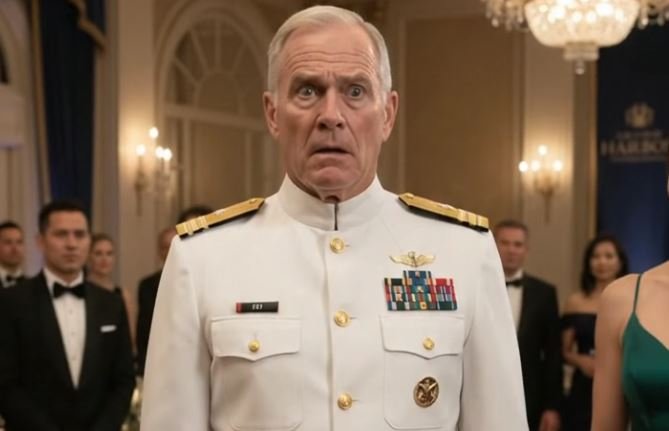
In the center aisle, directly beneath the grand seal of the United States Navy suspended from the mezzanine, a man stood motionless.
He was seventy-eight years old, six feet two inches of straight, unyielding line, wearing dark Navy service dress with four stars blazing on each shoulder board. His chest was an unbroken wall of campaign ribbons, dominated by the pale blue ribbon of the Medal of Honor, its tiny white stars stark against the silk.
Admiral Thomas Reddick.
The man who had commanded two carrier strike groups, who had rewritten modern littoral warfare doctrine, and whose retirement had done nothing to diminish the terror his name inspired in procurement officers who tried to cut corners on hull integrity.
A broken tumbler lay in wet pieces around his polished dress shoes. Scotch pooled across the white marble border of the carpet. His face was the color of weathered granite.
Derek’s breath hitched. He dropped his gaze to the spilled glass, then looked back at me, his face pale with sudden, panicked calculation.
“Jesus, Mara,” he hissed under his breath, his lips barely moving. “Look what you did. He was listening to the noise from this table.”
“Derek—”
“Shut up. Sit down.”
Derek grabbed my left forearm, his fingers digging hard into the muscle, trying to force me into the nearest banquet chair. “Sit down before this gets worse. He’s coming over here. He’s going to tear someone apart for decorum.”
The Admiral was moving.
He did not walk with the hurried step of an angry old man. He marched with the slow, terrifying cadence of an approaching front. His shoes clicked against the marble border with the precision of a metronome. The crowd parted before him like water, hands instinctively moving toward trouser seams, but Reddick looked at none of them. His pale gray eyes were locked on our table.
Derek took a deep, shuddering breath, released my arm, and stepped out into the aisle. He threw his shoulders back, smoothed his satin lapels, and assembled the posture of an executive preparing to defuse a subordinate’s blunder.
“Admiral Reddick, sir,” Derek began, his voice dropping into its most resonant, deferential register. He extended a hand. “I am Derek Halston, Vice President of Strategic Accounts for Halston Marine. Sir, on behalf of our company, I want to apologize profusely for the distraction. My fiancée had a slight mechanical difficulty with her footing, and—”
Reddick didn’t stop. He didn’t even look at the outstretched hand.
“Move,” Reddick said.
The word was not shouted. It was delivered with the flat, chilling finality of an anchor dropping into deep water.
Derek froze. His hand hung suspended in the empty air between them.
“Sir, if I could just explain that Halston Marine’s proposal for the—”
“I said move out of my way, son,” Reddick repeated, his voice dropping an octave. “Before I have the Shore Patrol carry you out by your cummerbund.”
Derek stepped backward so quickly his heel struck the base of the banquet chair, nearly sending him sprawling. His face drained of all color, leaving him hollow, slack-jawed, and utterly bewildered.
The Admiral stepped past him.
He stopped thirty inches from where I stood.
For five seconds, the entire room was so quiet I could hear the faint hum of the refrigeration units behind the service doors. Reddick’s eyes swept down my frame. They lingered on the exposed carbon-fiber pylon of my right leg, took in the surgical scars visible just above the suspension sleeve, and then rose slowly to meet my face.
The hard, predatory lines around his mouth softened. The gray eyes, which had sent admirals and congressmen into stuttering retreats for forty years, grew suddenly, remarkably bright.
“Mara?” he whispered.
My throat closed. The ballroom, the chandeliers, Derek’s terrified breathing three feet away — all of it dissolved into a gray fog of memory, replaced by the smell of diesel fuel, burning insulation, and the terrifying black roar of seawater rushing through a breached bulkhead.
“Yes, sir,” I managed, my voice steady despite the hammer of my heart. “Lieutenant Commander Ellison?”
A collective gasp rippled through the nearest tables. Frank Vance’s mouth actually fell open. Beside me, Derek looked as though someone had struck him across the bridge of the nose with an iron pipe.
“It’s been ten years, Admiral,” I said quietly.
Reddick took a slow, shuddering breath. His chest rose, the medals clinking softly against each other — a quiet metallic music that seemed to command the attention of every living soul in that hall.
“Ten years,” he murmured. “Ten years of searching personnel registries that your friends in the Bureau kept redacting on your behalf.”
Then Thomas Reddick — the legendary terror of the Pacific Fleet, a man who had not bowed his head to presidents — did something that made four defense contractors at table two drop their forks onto their china.
He brought his polished heels together with a sharp, crisp clack. He raised his right hand to the brim of his dress cover, executing a salute so rigid, so formally perfect, that it looked as though it belonged on the deck of a battleship during a state funeral.
My spine straightened on instinct. The muscle memory of twelve years of service surged through my nerves, overriding the dull ache in my left hip, overriding the clumsy weight of the prosthetic.
I brought my hand up and snapped a salute back.
“Commander,” he said, his voice carrying clearly to every corner of the frozen room, “lower your hand.”
I lowered it.
Reddick did not drop his arm to his side.
Instead, he stepped forward, bent his tall frame, and dropped his right knee squarely onto the hard marble floor in front of me.
A strangled sound came from Derek’s throat. “Babe…?”
Reddick didn’t care. The old warrior knelt on the floor, reaching out with hands that trembled slightly with age and emotion, and gently gathered the hem of my emerald silk gown. With the deliberate, reverent care of a priest tending an altar, he drew the fabric down, smoothing it over the black composite socket, over the titanium pylon, until the mechanical joints were once again covered and protected from the staring eyes of the room.
He looked up at me from the floor, his eyes wet.
“Ten years,” the Admiral said, his voice cracking slightly before he mastered it. “Ten years, and I still haven’t thanked you for bringing Julian out of that engine room.”
[Only Chapter 1 was published publicly at the source. The remainder of this story is a continuation that resolves the threads the chapter opens.]
Chapter 2: The Name They Erased
The word Julian traveled through the ballroom like a shockwave.
I watched it happen in stages. First came the confusion — three hundred people trying to place a name that clearly belonged to something enormous. Then came the recognition, rippling outward from the older officers at the back tables, the ones whose ribbons were faded and whose hearing aids whistled faintly in the silence.
Frank Vance set down his glass very carefully, as though it might detonate.
“Julian Reddick,” he said. “My God. The Providence.”
A woman near the dais pressed both hands to her mouth.
I had spent ten years learning to live without being looked at. Now three hundred faces were fixed on me with an expression I had forgotten how to interpret — not pity, not disgust.
Reverence.
“Admiral,” I said, “please stand up.”
“Not yet.”
“Sir, you’re seventy-eight years old and you’re kneeling on marble.”
“I’m aware of my age, Commander. I’m also aware that the last time I saw your face, you were handing my son through a hatch into black water with your flight suit on fire.” He said it evenly, the way men say things they have rehearsed for a decade. “I have been waiting a long time to be on my knees in front of you.”
Derek made another small strangled noise.
I looked down at the old man and felt something in my chest give way — a wall I had built so carefully, brick by brick, in a hospital bed in Landstuhl, in a rehabilitation gym in Bethesda, in every room where I had decided that the simplest way to survive was to become small.
“He’s alive,” I said. It came out as a question.
Reddick’s face broke.
“He’s alive,” he said. “He’s twenty-nine. He flies for the Coast Guard out of San Diego. He has a wife and a daughter and a temper he inherited from his mother.” He paused. “He has spent ten years trying to find you. He wrote to the Bureau. He wrote to the Navy. He wrote to a woman named Mara Halston who did not exist.”
Derek’s voice cut in, thin and reedy. “She — Mara, what is he talking about? You told me you were a contractor. You told me you did logistics.”
The Admiral turned his head slowly, and Derek took another step back.
“You,” Reddick said, “are going to want to stop talking.”
I put a hand on the Admiral’s shoulder. “Sir. Let him stand up.”
He stood. It cost him something — I saw it in the way his jaw tightened — but he stood, and he offered me his arm.
“I need some air,” I said.
“Then we’ll get you some air.”
We walked out together, my hand on his sleeve, past three hundred people who had been laughing at me four minutes earlier. The aisle felt a mile long. My right knee hissed softly with each step, that tiny hydraulic sigh I had long since stopped hearing.
At the doors, I looked back once.
Derek was still standing beside the banquet chair, holding the back of it with both hands, staring after us with his mouth open. Frank Vance had already turned away from him and was speaking quietly to the man beside him, and I knew — with a certainty that settled into me like cold water — exactly what was being said.
Halston Marine’s contract with Naval Sea Systems was worth four hundred million dollars.
It was going to be fine.
Right up until it wasn’t.
Chapter 3: The Man Who Said Half
The hotel had a small, quiet terrace on the harbor side, away from the cameras and the ice sculptures. The Admiral guided me to a bench and then, without asking, took off his dress jacket and put it around my shoulders.
It smelled of wool and starch and something faintly like pipe tobacco.
“You don’t have to do that, sir.”
“I am aware.”
We sat in silence for a while. Below us, the harbor lights moved gently against black water.
“Tell me what happened to you,” he said finally. “All of it. Not the citation. The citation I’ve read so many times I could recite it. Tell me what happened after.”
So I did.
I told him about Landstuhl, where the surgeons had taken my right leg above the knee and told me I was lucky. I told him about the eleven months of rehabilitation, the socket that rubbed my femur raw, the day I fell in a parking lot and a stranger had to help me stand. I told him about the medical board, the honorable discharge, the paperwork that changed my rank to retired and my status to former.
I told him about the second thing that happened, the one that mattered more than the leg.
“The Bureau offered me a new identity,” I said. “Not because of the injury. Because of the investigation that followed the fire. The board of inquiry wanted to know how a fuel line in an engine room on a deployed frigate had been installed with a counterfeit pressure fitting.”
Reddick went very still.
“You found something.”
“I found the purchase order.” I looked out at the water. “I found the name of the supplier, the name of the inspector who signed off on the falsified certificate, and the name of the contractor whose acquisition officer expedited the shipment.”
“Say it.”
“Halston Marine.”
The word sat between us.
“The inspector was never charged,” I said. “Neither was the acquisition officer. The file was sealed. The supplier dissolved. And I was told, in a very polite room, that it would be better for everyone if Lieutenant Commander Ellison ceased to exist and a woman named Mara Lane moved to Boston and found work in the private sector.”
“And Derek Halston?”
I let out a breath. “Derek was the man the company sent to manage me.”
Reddick turned his head slowly.
“Not to threaten me,” I said. “Nothing that crude. They sent someone charming. Someone who could take a broken veteran out to dinner and make her feel wanted and, in the process, keep a very close eye on what she remembered.”
“And you married him.”
“I engaged him,” I said. “I let him put a ring on my finger because it was easier than explaining why I didn’t want one. And because — for about eighteen months — I thought he might actually be kind.”
I looked down at my hands.
“He wasn’t. He was just good at appearing kind in front of people who mattered. Tonight wasn’t the first time. It was just the first time anyone heard him say it.”
Reddick was quiet for a long moment. Then he said, in a voice like a closing door, “He called you half a woman.”
“Yes.”
“In a room full of the men who buy my ships.”
“Yes.”
“Did he know what you did?”
I thought about it honestly. “I think he knew a version. I think the company knew I’d been injured in a fire and that there had been an inquiry and that the results were sealed. I think Derek was told to keep me away from anyone who might open it again. And I think he decided, somewhere along the way, that a woman with a prosthetic leg was a woman he could safely despise.”
The Admiral stood up and walked to the railing. For a while he just looked at the harbor.
“Commander,” he said, “do you know why I came to this gala tonight?”
“No, sir.”
“Because I am eighty in two years and I have decided to stop being polite.” He turned around. “I am going to stand up in front of that room in about four minutes and tell them what happened aboard the Providence. Every name. Every purchase order. Every sealed file. And then I am going to ask the Secretary of the Navy, who is standing by the bar pretending not to hear any of this, to reopen the inquiry.”
“Sir—”
“You do not have to testify,” he said. “I will not ask you to. But you should know that the moment I open my mouth, there will be no version of the next ten years in which Derek Halston has a career.”
I sat with that.
Somewhere in the building behind me, there was a table with a chair I had nearly fallen into, and a man who had laughed, and a hundred and forty people who had laughed with him.
“Admiral,” I said. “I’d like to come back inside.”
His eyebrows lifted. “Why?”
“Because I spent ten years letting people decide what I was allowed to say.” I stood up, and my right knee whined softly, and I ignored it. “I’d like to say something.”
Chapter 4: The Room Went Dead
We walked back in together.
The ballroom had changed in the twenty minutes we had been gone. The music had stopped. The dance floor stood empty. People had clustered at their tables in the peculiar frozen posture of a party where something has gone wrong and nobody has yet been told what to do.
Derek was still at table four. He had been joined by two men in matching lapel pins — a lawyer and a communications director, I assumed — and the three of them were speaking in the rapid, overlapping way of men trying to build a lifeboat out of conversation.
He saw me and his face did something complicated.
“Mara.” He crossed the distance in four strides. “Mara, thank God. Where did you go? I’ve been trying to reach you, my phone’s been —” He stopped, because I was not looking at him.
I was looking at the microphone at the dais.
“Mara?” His hand closed around my elbow. “Mara, sweetheart, let’s go outside and talk. Let’s go home. I know tonight got out of hand, and I said some things, and I want to apologize properly, but the thing is, the contract with NAVSEA is —”
“Derek.”
“— the contract is everything for my father, and if we could just keep this quiet for a few weeks, I swear to God I will make it up to you —”
“Derek.”
He stopped.
I turned and looked at him, really looked at him, the way you look at a room you are leaving.
“Did you know what happened on the Providence?”
His eyes flickered. “What? Of course I — I know you were in a fire. You told me —”
“Did you know that the fire started because Halston Marine shipped a counterfeit pressure fitting, and that when the inquiry got close to the truth, someone at your father’s company arranged for a decorated officer to be quietly erased?”
His hand fell away from my arm.
“That’s — no. No. That’s not — Mara, that’s a conspiracy theory, that’s — my father would never —”
“Your father sat in the room,” I said. “I have the minutes. I have been sitting on them for ten years, because I was told that if I ever used them, I would be the one who paid.”
The color had gone out of him entirely.
“But you knew,” he said, and his voice cracked on it. “You knew, and you let me — you let me say what I said tonight, and you never told me —”
“I let you,” I said quietly. “That’s true. I let a great many things happen because I was afraid, and because I had convinced myself that being overlooked was the price of being safe.” I looked at the room. “I was wrong about the price.”
I walked to the dais. The Admiral walked with me, one hand hovering near my back, not touching.
The master of ceremonies was a gray-haired man in a commodore’s uniform who looked as though he had aged five years in twenty minutes. He saw us coming and stepped aside without a word.
I took the microphone.
Three hundred people turned.
For a moment I couldn’t speak. Not from fear. From the sheer strangeness of it — my voice, in a room like this, with nothing to hide behind.
“My name is Mara Ellison,” I said.
The microphone carried it into every corner.
“I am a lieutenant commander in the United States Navy, retired. Ten years ago I was the damage control officer aboard the USS Providence. On the night of March 3, a fuel line in the number two engine room failed because a pressure fitting installed by a subcontractor did not meet specification. The fire killed two sailors and injured eleven. I lost my right leg getting a machinist’s mate out of that compartment.”
I paused.
“His name is Julian Reddick. He is alive. He flies helicopters for the Coast Guard.”
Somewhere at the back of the room, a woman began to cry.
“In the months that followed, an inquiry was opened into how that fitting came to be aboard a United States warship. The inquiry found that the fitting had been supplied through a chain of vendors ultimately tracing to Halston Marine. It found that the inspection certificate had been falsified. It found that the officer who signed off on the expedited shipment had done so without verification.”
I let that sit.
“The inquiry was then sealed. The file was classified. And I was asked, in the gentlest possible way, to disappear.”
I looked at Derek.
“Tonight, at table four, a man who has been my fiancé for three years described me to this room as half a woman on a good day. He said it while I was standing beside him with my leg exposed, in front of the men who buy his ships. And a number of you laughed.”
The silence was absolute.
“I want to be clear about something,” I said. “I am not asking for sympathy. I have a good life. I have work I love, and I have a mechanic who understands my knee better than most doctors, and I have a mother in Ohio who still sends me coupons for things I don’t buy.” A small, startled laugh came from somewhere near the bar. “I am not half a woman. I am a whole one. It took me a long time to be able to say that out loud in a room, and I would like to thank the man at table four for making it necessary.”
Derek’s lawyer had his hand on his client’s shoulder. Derek was staring at the floor.
I turned to the Admiral.
“Sir,” I said. “I’d like to hand you the microphone.”
Chapter 5: The Medal and the Minutes
Thomas Reddick took the microphone the way he had taken everything in his life: without hurry.
He did not raise his voice. He did not need to.
“I have been asked by three different people in the last ten minutes to be careful,” he said. “I want to say, for the record, that I intend to be extremely careful. Everything I say tonight is on file, in documents my staff will release to the press within the hour, in a sealed inquiry I have had unsealed by the Secretary of the Navy in a phone call that took four minutes.”
He looked at the Secretary, who was standing near the bar with a face like a man who had eaten something unexpected.
“The Providence inquiry found that the falsified inspection certificate was signed by an employee of Halston Marine named Warren Coles. Mr. Coles was never charged. He was promoted. He is currently Vice President of Compliance at Halston Marine. He is in this room.”
A chair scraped.
“The expedited shipment authorization was signed by Douglas Halston, then Chief Operating Officer, now Chairman. He is also in this room.”
Derek’s father stood up slowly from a table near the dais. He was a big man in a good suit, and he looked — to his credit — not frightened. Resigned.
“Tom,” he said. “Not here.”
“Yes, Doug,” Reddick said. “Here.”
“There are reporters in this room.”
“I know. I invited them.”
The room made a sound like a held breath.
“The Providence inquiry was sealed,” Reddick continued, “on the recommendation of a legal review that concluded that public disclosure would create unacceptable exposure for a critical defense contractor during a period of active procurement. In other words: keeping it quiet was good for business.”
He looked around the room.
“I signed that recommendation. I want to be very clear about that. My signature is on the document that buried Lieutenant Commander Ellison. I did it because I believed the fleet needed those ships more than it needed the truth, and I have had ten years to consider whether I was right.” He paused. “I was not.”
The Admiral turned and looked at me.
“Commander Ellison did not ask to be here tonight. She did not ask for this microphone. She has spent a decade building a quiet life and letting people believe whatever was convenient about her, and she did it because she was told that the alternative was a fight she could not win.” He turned back to the room. “I am here to tell you that she has already won it. She won it in an engine room at four in the morning with her flight suit on fire. Everything since has been bookkeeping.”
He set the microphone down on the lectern.
Then he turned to Douglas Halston and said, in a voice that carried to every corner of the ballroom, “Doug, I am going to ask you to leave now. Not because I have the authority. Because I am asking.”
Douglas Halston looked at the Admiral for a long moment. Then he looked at his son.
Derek did not look back.
The older man straightened his jacket, picked up his glass, and walked out of the ballroom alone. The sound of the doors closing behind him was very quiet, and very final.
Chapter 6: What Was Owed
The investigation reopened the following Monday.
It took eleven months. Warren Coles, the compliance officer who had signed the falsified certificate, was indicted on three counts of fraud and one count of making a false statement to a federal agency. He pleaded guilty in the spring and agreed to testify. Douglas Halston was indicted on charges of conspiracy and obstruction. He was convicted the following year and sentenced to four years.
Halston Marine paid a settlement of two hundred and forty million dollars and was barred from bidding on Navy contracts for five years. The company survived, technically. It was not the same company.
Derek was not charged. He had not known — not really, not in the way that would survive a courtroom — and I have thought about that a great deal. I believe him. I believe he was told a sanitized version of a story and chose, as people do, to believe the version that was most convenient.
What he did to me at that table was not a crime. It was simply what he was.
He called me seventeen times in the two weeks after the gala. I did not answer. He left a voicemail at three in the morning, drunk and crying, saying that his father had not spoken to him since the ballroom and that he had lost his position at the company and that he was sorry, he was so sorry, he had not meant it, he had been scared.
I listened to that voicemail once. Then I deleted it.
In April, I received a letter from the Department of the Navy. It restored my rank, my retirement benefits, and my service record. It contained a citation, signed by the Secretary, upgrading my commendation to the Navy Cross for “extraordinary heroism in the face of grave personal risk.”
I read it in my kitchen with my prosthetic propped on the opposite chair, because I had taken it off the moment I got home, the way I always did.
Then I put it in a drawer and made a cup of tea.
Chapter 7: The Man in the Engine Room
Julian Reddick came to Boston in June.
He called first. That was the thing I remember most clearly — he called, and he asked, and he did not assume.
“Commander Ellison,” he said. “This is Julian Reddick. I don’t know if you remember me.”
“I remember you.”
“I’d like to buy you a coffee. Or a very large drink. Or both, in some order.”
We met at a diner near the harbor. He was taller than I expected, and he had his father’s jaw and his mother’s laugh. He had brought a photograph: a little girl, four years old, in a Coast Guard cap, standing on a dock.
“This is Ellie,” he said. “She’s named after you.”
I had to put the photograph down for a moment.
We talked for four hours. He told me about the hospital, the burns on his back, the year he spent learning to sleep with the light on. He told me about the Coast Guard, and the rescue swimmer training, and the fact that he had spent a decade trying to find a woman named Ellison and being told, every single time, that no such person existed.
“They told me you’d died,” he said. “In the fire. That’s what the letter said.”
“I know. They told me you’d died too.”
He looked at me for a long moment. “Why would they do that?”
“Because two dead people can’t testify,” I said.
He nodded slowly. He had the same face his father made when he was deciding to be calm.
“My father,” he said, “has spent ten years being angry at himself. I want you to know that. He has not been an easy man to live with.”
“He kneeled on a marble floor in front of three hundred people,” I said. “He’s doing fine.”
Julian laughed. It was a good laugh, whole and uncomplicated.
“He wants to give you his Medal of Honor,” he said. “I told him it doesn’t work that way, and he told me he didn’t care how it worked.”
“Tell him no.”
“I did. He said, and I quote, ‘Then tell her I’ll hold onto it until she changes her mind.’”
We sat with that for a while, both of us smiling at the tabletop.
“Commander,” Julian said, “can I ask you something that isn’t any of my business?”
“You can ask.”
“Are you happy?”
I thought about it honestly. It was not a question I had been asked in a long time.
“I’m getting there,” I said. “I’m learning that being looked at and being seen are not the same thing.”
Julian nodded. “I’m going to be in Boston a lot,” he said. “Coast Guard business.”
“Is that true?”
“Not even slightly.” He grinned. “But Ellie has never been to the East Coast, and I have a feeling she’d like it.”
Chapter 8: The Woman Whole
The following spring, I went back to the Grand Harbor Hotel.
Not to the gala. The annual maritime defense dinner had been moved to a different venue that year, partly for scheduling reasons and partly, I suspect, because nobody wanted to be photographed in that ballroom again.
I went because Julian had asked me to, and because his father was retiring for the second and final time, and because there was something I wanted to say in a room full of people who had once laughed.
The Admiral’s retirement dinner was smaller. A hundred and fifty people. No cameras. No press.
When they asked me to speak, I stood up and looked out at the tables and thought about how strange it was that a room could hold the same number of chairs and the same chandeliers and still be an entirely different place.
“I want to tell you a story about a man who said half a woman,” I said.
The room went very still.
“He said it in this hotel, at a table very much like that one, in front of three hundred people who had spent their entire lives learning how to pretend not to hear. And a number of them laughed. And I stood there with my leg exposed and my dress ruined and I thought: this is the price. This is the price of being here, and I will pay it, because I have always paid it.”
I looked at the Admiral, who was sitting in the front row with his hands folded, watching me with an expression of enormous, quiet pride.
“I was wrong about the price,” I said. “The price was not my dignity. The price was my silence. And I paid it for ten years, in installments, until a seventy-eight-year-old man on his knees on a marble floor reminded me that I had never actually been the one who owed anything.”
I raised my glass.
“To Thomas Reddick. Who is not half a man on any day.”
The room stood up.
Afterward, in the lobby, the Admiral took my arm and walked me out to the harbor. The lights were the same as they had been a year earlier. The water was the same.
“Commander,” he said. “I have one more thing to ask you.”
“Sir?”
“I have a foundation. It’s small. It funds prosthetics for veterans who can’t get them through the VA, and it funds lawyers for veterans who can’t get them through anything. I have been running it badly for four years.” He looked at me. “I would like you to run it.”
I stopped walking.
“Sir, I’m a damage control officer. I don’t know anything about running a foundation.”
“You know how to keep a ship afloat with a hole in it,” he said. “That’s all a foundation is.”
I looked out at the water and thought about the engine room, and the black roar of it, and the boy I had handed through a hatch.
“Yes,” I said. “All right.”
The Admiral smiled. It was the first uncomplicated smile I had ever seen on his face.
“Good,” he said. “Because I’ve already drawn up the paperwork, and I’m not getting any younger.”
We walked on.
Behind us, the Grand Harbor Hotel stood lit up against the dark, full of people in good suits saying careful things to one another. Ahead of us, the harbor opened out into the black and the cold and the long, wide water.
I was a whole woman, walking on a leg made of steel, with a man who had once signed the document that buried me and had spent ten years learning how to kneel.
It was not the life I had planned.
It was, I had finally decided, a better one.
THE END