I went to the orchard every October. It’s the one tradition I kept from my mother — she died in spring six years ago, and October belongs to her: the picking, the pressing, the smell of bruised apples and wood smoke, the way morning mist sits between the rows like the whole orchard is thinking. I go alone. I go early. I take the same row at the back of the property, the one with the oldest trees, because nobody else bothers with it and the apples up high are the best ones anyway.
The first morning I noticed him, I assumed he worked there. Henley, work boots, holding a wooden bin at the base of my ladder — steady, present, wordless. Orchard hands do that, I figured. I kept picking. When I finally finished the tree and climbed down, he was gone, and the bin — which I’d assumed was the orchard’s — was gone too.
Second morning: same man, same bin, positioned at the base of my ladder the moment I set it up. This time I said “good morning.” He nodded. That was the entire exchange. I picked for an hour. He held the bin. When I climbed down, he was gone.
Third morning, I brought my friend Priya, who assessed the situation from the next row and delivered her verdict in a whisper: “That man has never worked here a day in his life. Look at his hands. Those are architect hands. He’s renting this experience.”
“He’s holding a bin.”
“He’s holding a delusion, and it’s working.”
Priya lasted one morning before declaring the whole thing “better than any streaming service” and abandoning me to it. By morning ten, I had a system: I’d pick the top branches slowly, inventing reasons to stay on the ladder — one more apple, one more check of the light — because the row ended when the ladder came down, and the ladder coming down meant he’d vanish like October mist, and October was three weeks long, and I was doing math on a stranger’s patience.
On morning thirty — the last Saturday of the month, the orchard’s last you-pick weekend — I stopped pretending. I stood on the ladder, looked down through the leaves at a man who had held a wooden bin for thirty mornings, and said what I’d been not-saying for a month.
“I’ve been picking this row for an hour. You’ve steadied that bin the whole time. And you haven’t said a single word or moved your eyes off me.”
He didn’t speak. He set the bin down — carefully, like it contained something — and climbed one rung of the ladder. One rung. The smallest possible distance, and it took him thirty mornings.
“If the orchard owner drives by on the tractor,” I breathed, and my hand on the branch had gone tight, “he’ll see a customer and a man one rung too close—”
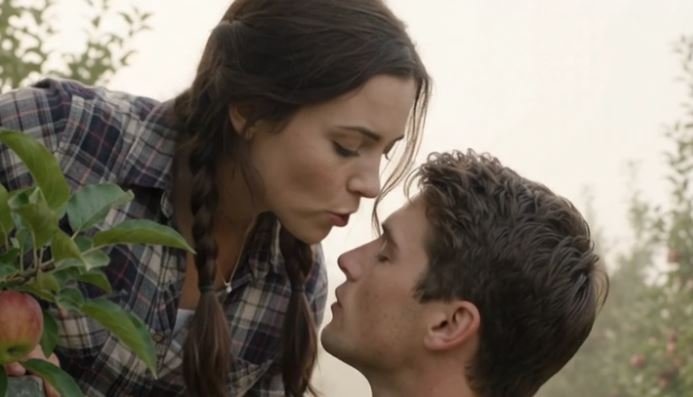
He reached up, turned my face down toward his with a hand on my jaw, and kissed me. Slow. Picked. October air, wet leaves, the far-off smell of donuts, and an hour of my pulse in my ears.
The tractor grew louder. The owner — a broad, gray-bearded man named Walt — pulled up alongside the row, killed the engine, and took in the scene: me on the ladder, him one rung below, the empty bin, the month of it.
“FINALLY!” Walt hollered, with the fury of a man releasing classified information. “He’s been renting that bin every morning for a month! Paid cash! Said, and I quote, ‘I don’t need the apples, I need the row!'” He restarted the tractor, muttering, but loud enough: “Thirty mornings. I got a mortgage older than this courtship.”
We were laughing when we broke apart — the helpless kind, the kind that’s been stored too long. He climbed down, offered me his hand, and for the first time in thirty mornings, spoke. His voice was rough with disuse, like a machine started after winter.
“Daniel. The bin rental was Walt’s idea, to be fair. I asked if I could just stand here, and he said that would be ‘creepy without produce.’ He rented me the bin for a dollar a morning and said the apples were non-refundable.”
The bin. I looked in it — thirty mornings, and it had been empty every time, I’d checked. Not today. Today it held exactly one apple, dark red, perfect, and balanced on it, a folded paper bag note in careful handwriting:
I don’t come for the apples.
“Then why—” I started, and stopped, because the ladder was still between us and the answer was one rung away and I’d known it since morning ten.
“I come because my sister used to bring me here,” he said, quieter. “She died in March. This was her orchard — her October, not mine. First morning, I saw you in her row, picking her tree, reaching exactly the way she did, and I—” He stopped. Started over. “The bin gave me a reason to stay. I wasn’t ready to say why. Then I was ready, and thirty mornings had gone by, and I figured I’d missed the window, and Walt said — Walt said, ‘Son, the season ends when the trees say, not when you chicken out.'”
Walt, from the next row over, where he had absolutely not driven away: “I said it louder than that!”
We went to the cider press together — the real reason he’d lingered, I understood now; his sister’s tradition included pressing, and he couldn’t face the building alone. So we faced it together: two strangers and a bin of apples I’d finally helped pick, and when the first cider ran, Daniel put his cup down and cried, once, into the October air, and I held his hand in the wet grass, and Walt pretended very hard to fix the tractor.
We pressed cider every October since. We’re married three years now, and the orchard sells it bottled — the back-row blend, the high-branch apples nobody bothers with. The label is my photograph of that row in morning mist. The name, in Daniel’s careful handwriting, is the note from the bin:
I DON’T COME FOR THE APPLES.
Walt keeps the dollar-a-morning ledger framed in the farm store. Under the last entry, in his handwriting:
“Best rental I ever ran. Would’ve done it free.”