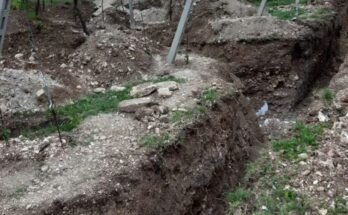
The seismic sensors at Sector 4 weren’t supposed to redline for another six months. But at 4:18 PM, a surprise phreatic eruption tore open the northern flank of the Mount Saint Helen caldera, sending a forty-thousand-foot plume of superheated ash and toxic sulfur gas into the sky. Within four minutes, a dense, pitch-black pyroclastic ash cloud rolled down the valley, plunging the entire forestry research outpost into total darkness.
Senior Volcanologist Dr. Victor Vance was trapped inside the mobile observation unit when the primary blast wave hit. The concussive force flipped the three-ton armored trailer onto its side, pinning Victor’s legs under the steel battery rack. Heavy, suffocating ash began pouring through the shattered ventilation ducts, rapidly replacing the breathable oxygen inside the cabin with deadly sulfur dioxide. His radio was transmitting pure static, and the toxic ash cloud outside reduced visibility to absolute zero.
Lying on the tilted floor, struggling to draw a single breath through his wet filter mask, was Shadow—a magnificent, four-year-old silver-coated Siberian Husky. Trained for extreme Arctic weather, Shadow’s double-layer coat and high-capacity lungs gave him a unique tolerance to harsh airborne particles, but an ash storm was unlike anything he had ever faced.
Victor’s vision was blurring as carbon monoxide levels spiked inside the cabin. He looked through the hazy red emergency light at Shadow, his voice cracking painfully into his oxygen mask.
“Shadow… hear me!” Victor coughed, pointing a shaking hand toward the sealed floor hatch beneath the battery bank. “The air line… Section B! It’s buried under the solar casing! Clear it before the sulfur seals the valve!”
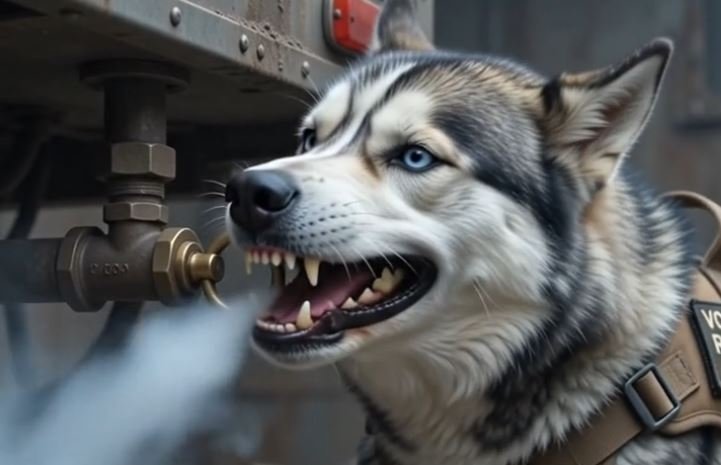
Shadow didn’t hesitate. He scrambled up the tilted aluminum floor, his claws digging into the rubberized floor mats. Ignoring the searing heat of the metal casing, Shadow jammed his snout into the narrow gap beneath the battery rack. Working with frantic, precision instinct, he began tearing away the melted rubber insulation and burning debris with his powerful teeth.
Using his heavy paws, Shadow dug through six inches of scorching ash that had accumulated around the emergency intake valve. He clamped his jaws onto the brass emergency release ring, bracing his hind legs against the overturned desk, and pulled backward with immense force.
With a loud pneumatic hiss, the secondary oxygen reserve kicked in, flushing clean air into the cabin and blowing the deadly sulfur cloud back out through the vents.
However, the loud hiss triggered a secondary shift in the unstable trailer. Outside, a massive river of superheated mud and volcanic debris—a lahar—was roaring down the gulch straight toward the trailer’s resting position…
When the National Guard hazard team located the overturned trailer two hours later using thermal imaging, they cut through the side door to find Victor conscious, his face pressed against Shadow’s chest as the dog lay over him, shielding his handler from the falling volcanic debris.
The hazard unit commander stared in awe at the air readings inside the cabin and murmured: “There’s no way the air stayed clean in here for two hours…”
Victor raised his hand, resting it on Shadow’s head: “It didn’t. He dug out the oxygen valve with his bare paws.”