The sidecar detached. It rolled. It flipped. It came to rest upside down in the scrub grass, 30 feet from the road.
Duke crawled out.
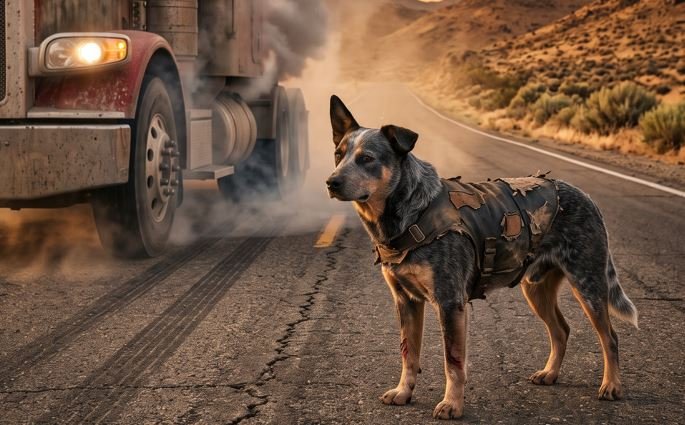
His goggles were gone. His vest was torn. His left front leg — the one he favored since the coyote incident two years back — was bleeding, maybe broken. He limped. He stumbled. He fell.
Then he heard Frank.
The sound wasn’t words. It was breathing. Ragged. Wet. The sound of a lung that had found something sharp inside itself. Duke knew that sound. He had heard it once before, in the shelter, when the dog in the next kennel had been hit by a car and lay dying through the night.
He ran.
Not toward the sidecar. Toward the road. Toward Frank.
The bike lay on its side, leaking gasoline into the hot asphalt. Frank lay beyond it, 20 feet from the guardrail, his body twisted in a way that bodies aren’t meant to twist. His helmet was cracked. His eyes were open. He was trying to move his right arm. It didn’t move.
Duke reached him and stopped.
He didn’t lick Frank’s face. He didn’t whine. He assessed. Nose to mouth — breathing, bad but there. Nose to chest — movement, shallow but there. Nose to leg — blood, too much, pooling in the gravel.
Then Duke did what no training had taught him.
He ran again.
Not to Frank. Past him. Toward the guardrail. Toward the highway beyond. His leg screamed. His lungs burned. The asphalt was hot enough to sear his pads. He didn’t feel it. He felt only the rhythm of Frank’s breathing behind him, counting down.
He reached the highway. He stood in the lane.
A semi truck bore down on him. Horn blaring. Duke didn’t move. He stood his ground — one ear up, one ear down, blood dripping from his leg — and barked. Not a warning bark. A command bark. Stop. Now.
The truck locked its brakes. Tires smoked. It stopped 10 feet from Duke’s nose.
The driver jumped out, cursing, furious — until he saw the dog’s leg. Until he saw the blood on the asphalt. Until he followed Duke’s gaze to the guardrail, to the bike, to the body beyond.
Duke was already running back.
He led the driver to Frank. He stood over his owner while the man called 911. He growled when the driver tried to move Frank — a low, steady rumble that said don’t touch him, don’t make it worse, just wait. The driver waited.
The ambulance came. The paramedics worked. Duke didn’t let them near Frank until one of them — a woman with kind eyes — knelt down and offered her hand. Duke sniffed. He decided. He stepped aside.
But he followed the gurney. He limped beside it, his bad leg dragging, his good leg pumping, keeping pace with the wheels all the way to the ambulance. When they tried to close the doors, he jumped.
He missed. His leg gave out. He hit the bumper and fell.
The paramedic with kind eyes picked him up. She placed him inside, on the floor next to Frank’s head. Duke lay there, his chin on Frank’s shoulder, his eyes on Frank’s face, watching every breath.
Frank woke up three days later.
Broken ribs. Collapsed lung. Fractured pelvis. A concussion that stole his memory of the crash. But alive. More alive than he had any right to be.
The first thing he saw was Duke. Sleeping on his hospital bed, bandaged leg extended, one ear up, one ear down, snoring softly against Frank’s arm.
The nurses said they had tried to remove the dog. Duke had refused. He growled at orderlies. He snapped at doctors. He had claimed that bed like territory, and nobody was brave enough to challenge a dog who had faced down a semi truck.
Frank didn’t try to move him. He just reached over — slowly, painfully — and touched Duke’s good ear.
The tail thumped. Once. Twice. Then settled.
They went home six weeks later. Frank couldn’t ride. The doctors said maybe never. The bike was totaled anyway — frame twisted, engine cracked, ghost no more.
Frank sold the wreckage for parts. He used the money to buy a van. A white van, pearl finish, custom paint that caught the moonlight. He built a bed in the back. He put Duke’s sidecar in the corner, converted into a dog bed, goggles and vest and red bandana still intact.
They still take Route 66 every summer. But now Frank drives. Duke rides shotgun, head out the window, ears flapping, tongue lolling in the wind.
At stoplights, Duke still leans over and rests his chin on Frank’s thigh. Frank still doesn’t talk much. But sometimes — when the road is straight and the moon is high — he reaches down and scratches Duke’s good ear and whispers the only words that matter:
“You stopped a truck for me, you crazy mutt.”
Duke doesn’t answer. He just thumps his tail against the van seat and watches the road ahead.
Because some heroes don’t wear capes.
Some wear goggles and a red bandana.
And some don’t need engines to outrun death.