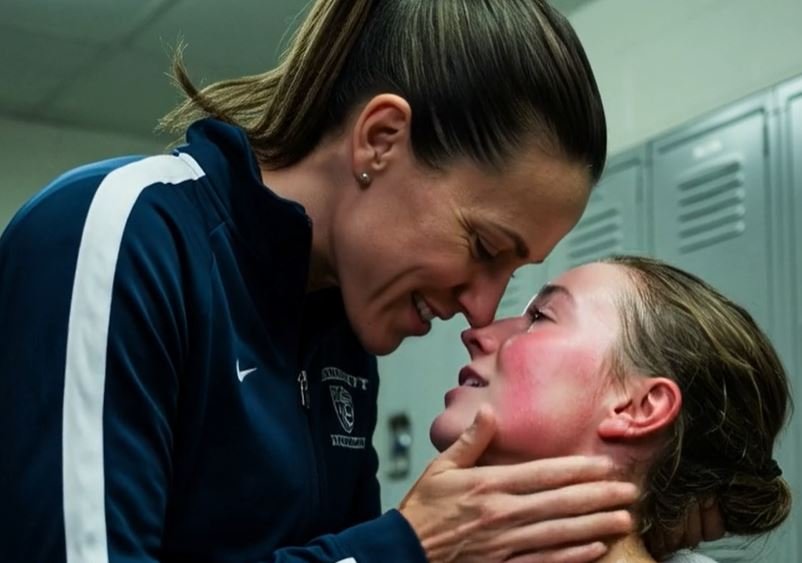
The locker room smelled like sweat and disinfectant and the particular kind of desperation that comes from young athletes who are trying to outrun something they can’t name. I’d been coaching for eight years. I’d smelled every variant of that desperation. I’d never been addicted to one until Riley.
She was twenty. A sprinter. The kind of runner who moved like liquid, like her bones were suggestions rather than requirements. She’d been my star recruit—full scholarship, Olympic potential, the kind of athlete who made donors write checks and administrators look the other way.
She was also my complete undoing.
“You missed practice,” I said. My voice carried the authority that had made me the youngest head coach in the conference, that had earned me the respect of athletes twice my age, that had built a program from nothing into national contenders. “Again. Third time this week.”
Riley looked down. Then back up. Her sports bra was soaked through, her running shorts clung to her thighs in a way that was definitely not regulation, and her towel was draped so loosely over her shoulders that it was more suggestion than coverage. She’d been running. Alone. On the track in the dark. I knew because I’d watched her from my office window, knowing I should go home, knowing I should let her fail, knowing I was already too far gone to stop.
I walked over. Three steps across the tile floor that I’d mopped myself after budget cuts my first year. Stopped in front of her. Reached down and lifted her chin with one finger, forcing her to meet my eyes.
“What am I going to do with you, Riley?” I whispered. “Tell me. What should your punishment be?”
Her eyes darkened. Her lips parted. She didn’t speak—she never spoke when I challenged her, had learned early that words were unnecessary between us, that her body was a language more articulate than any interview or press conference.
I smirked. The expression that terrified freshmen and made seniors work harder. Pulled her up by the chin—not gentle, not kind, exactly what we both needed—and kissed her hard.
My other hand found her waist. Her sweat soaked through my track jacket, through the fabric of my shirt, branding my skin with her exertion. She tasted like salt and Gatorade and the exact moment when discipline becomes desire, when authority becomes something that neither of us could control anymore.
My hand was on the waistband of her shorts, pulling them down with a violence that made her gasp against my mouth, when the gymnasium doors slammed.
We both froze. The sound was unmistakable—the heavy metal doors that separated the locker room from the court, the ones that should have been locked after 9 PM, the ones that meant someone else was here.
The team captain. Maya. Senior. Scholarship athlete. The kind of girl who showed up early and stayed late and had probably come back for the water bottle she’d left behind.
She stood in the doorway. Track jacket. Running shoes. Eyes wide, taking in the scene—her coach, her teammate, Riley’s shorts around her ankles, my hand on her thigh, both of us frozen like animals in headlights.
I should have pulled away. Should have fixed my jacket, smoothed my hair, made some excuse about stretching or injury assessment or any of the thousand lies that coaches tell when they’re caught in compromising positions.
I didn’t.
I looked at Maya. Really looked. At her flushed cheeks. At her parted lips. At the way her eyes traveled from Riley’s exposed body to my face and back again, not with shock, with hunger.
“You’re late,” I said. My voice was steady. Commanding. The voice that had won championships and lost my marriage and built an empire out of sweat and discipline. “Join us or leave.”
Maya didn’t leave.
She walked in. Closed the door behind her. Locked it with a click that echoed in the suddenly small room.
Riley looked at me, her eyes questioning, her body still trembling from where I’d touched her. I nodded. Once. Small. Definite.
Maya reached for her jacket zipper. Slow. Deliberate. Her eyes never leaving mine.
“I’ve been late on purpose,” she said. “Every night this week. Hoping I’d find something worth staying for.”
She found it.
What happened in that locker room became the foundation of something that had no name in the NCAA handbook. Riley on the bench, Maya against the lockers, me moving between them with a hunger that I’d suppressed for eight years of professional distance.
When Riley came, it was with her hand over her own mouth and my name breaking against her palm. When Maya followed, it was with her forehead pressed against the cold metal of the locker and Riley’s mouth on her breast. When I finally let go, it was with both of them watching, both of them touching, both of them whispering my title like it was a prayer and a curse.
Coach. Coach. Coach.
We’re still competing. Still winning. Still the top program in the conference. The donors don’t know. The administrators suspect but can’t prove. The team knows—somehow, they always know—but they also know that since that night, our relay times have dropped by two seconds and our team chemistry is the kind that wins championships.
Riley still misses practice. Maya still stays late. And I still “punish” them both, every night, in the locker room that smells like sweat and victory and the exact moment when authority becomes love.
Some teams are built on trust. Ours is built on something stronger.