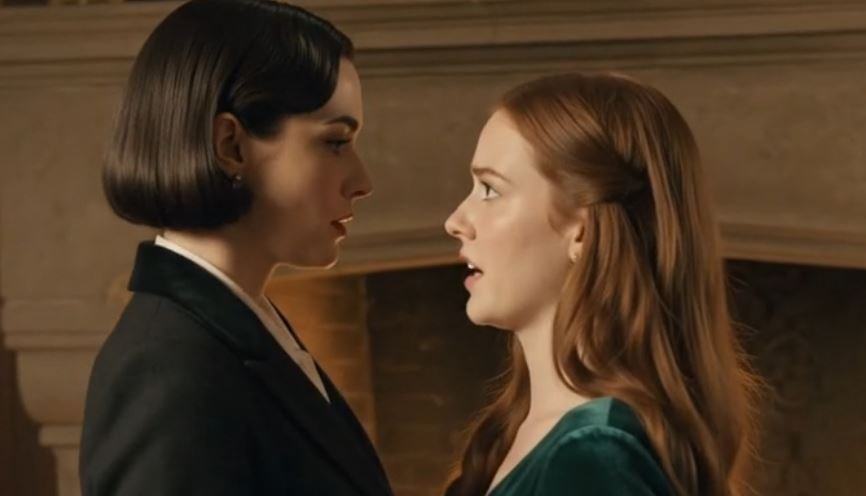
The Hart Estate was a Georgian mansion on forty acres of land that smelled like old money and older secrets. I’d married Richard Hart six months ago — a marriage of convenience, he’d called it. I was twenty-eight, drowning in student debt from a law degree I’d never used. He was fifty-eight, widowed, and in need of a hostess for his dinner parties. The arrangement was clear: my beauty for his bank account, my youth for his legacy, my body for his… well, that part had been theoretical. Richard had been kind but distant, more interested in his vintage car collection than his new wife.
Then he died.
Heart attack. Three weeks ago. Sudden, brutal, completely unfair to a man who’d just finished remodeling the east wing. The funeral was yesterday. The will reading was this morning. And the shock was still vibrating through my bones as I stood in the library, holding the envelope that the lawyer had pressed into my hand before leaving.
“To my wife, Elena,” the letter inside read, in Richard’s shaky handwriting. “And to my daughter, Sloane. The estate is yours. Jointly. Equally. With one condition.”
The condition was on a separate page. Typed. Legal. Binding.
The beneficiaries must reside together in the Hart Estate for a period of not less than twelve consecutive months. Should either party vacate the premises for more than seventy-two hours, the estate shall be liquidated and the proceeds donated to the National Trust for Historic Preservation.
We were trapped.
Sloane was twenty-two. Richard’s daughter from his first marriage. A PhD student in classical literature who’d hated me on sight at the wedding, who’d refused to make eye contact at dinner, who’d been the subject of every inappropriate dream I’d had since moving into this house.
She was sitting in the leather armchair when I read the clause aloud. Black mourning dress, blonde hair pinned up, legs crossed with a deliberateness that made me forget what I was reading.
“The will says we must live together for one year,” I said, my voice echoing in the library where Richard had first proposed to me. “In this house. Alone. Or we lose everything.”
Sloane didn’t speak. She just stood up — slowly, deliberately, like a predator who’d been waiting for the cage to close. She walked over, took the envelope from my hand, and let her fingers brush mine with an electricity that had nothing to do with grief and everything to do with the tension that had been building since the day we met.
“Your father knew,” I whispered, the realization hitting me like a physical blow. “He planned this. He wanted us trapped in this house with no one to hear us. He knew about us before he died. He saw us. In the garden. That night.”
Sloane’s eyes darkened. She turned me by the waist, her hands firm on my hips, and pulled me against her. Her mouth found mine — a kiss that tasted like legal documents and sin and the exact moment when a contract becomes a confession. It wasn’t gentle. It was teeth and tongue and the violence of a woman who’d been denied something for six months and was now being told she had a year to take it.
The housekeeper knocked.
“Mrs. Hart?” Mrs. Chen’s voice. Seventy years old, employed by the family for four decades. “Shall I bring tea?”
Sloane didn’t pull away. She just pressed me backward, toward the Persian rug, her mouth moving to my neck, her hands finding the buttons of my mourning dress.
“Not now, Mrs. Chen!” I called out, my voice strangled as Sloane’s teeth grazed my pulse point.
“Very well, madam.”
Her footsteps retreated. Sloane pushed me down onto the rug — the same rug where Richard had proposed, where I’d said yes to a life of comfort, where I was now being claimed by his daughter. She pulled my dress open, exposing me to the firelight, to the oil portraits of Hart ancestors who seemed to watch with disapproval.
“One year,” Sloane whispered against my thigh, her breath hot, her voice finally breaking the silence she’d maintained since entering the room. “Three hundred and sixty-five days. And I intend to collect every night. Every morning. Every afternoon when you’re supposed to be reading in the garden.”
Her mouth was on me then. No preamble. No gentleness. Just hunger. She used her tongue with a precision that spoke of study, of practice, of every moment she’d watched me across the dinner table and imagined exactly this. I came with her name breaking from my lips, my hands gripping the rug, my body arching into her mouth while the portraits watched and the fire crackled and the will lay scattered beside us like evidence.
After, she lay beside me on the rug, her head on my stomach, her fingers tracing patterns on my skin.
“Clause two,” she whispered, her voice amused, completely unlike the serious student I’d thought her to be.
“What?”
She held up the will. Pointed to a paragraph I hadn’t read.
Furthermore, should either party enter into a romantic or s/e/x/u/a/l relationship with the other, the estate shall be transferred in full to the initiating party, provided the relationship continues for the duration of the residency requirement.
I stared at her. “Your father incentivized us sleeping together?”
“He was a practical man,” Sloane said, kissing my shoulder. “He knew the only way to keep this house in the family was to make sure we had a reason to stay. And he knew — because he saw us in the garden — that we were already halfway there.”
We live in the mansion now. Mrs. Chen brings tea every afternoon. The lawyer checks in monthly. And every night, Sloane comes to my room — or I go to hers — and we fulfill the clause that Richard wrote with such deliberate precision.
The estate is ours. The house is ours. And every morning, when Sloane wakes up beside me and whispers “Good morning, stepmother,” I know that Richard got exactly what he wanted.
A family. Bound by law. And by something much stronger.