The bus hit the guardrail at 30 mph.
The metal groaned. It bent. It didn’t break — not immediately — but it bowed outward, the bolts screaming in their concrete anchors, the whole structure leaning toward the void.
Maria stood on the brakes. The bus stopped sliding. But it didn’t stop moving. Gravity had it now. The front wheels were on the road. The back wheels were over the edge. The guardrail held — barely — but it wouldn’t hold long. Twelve tons. Forty feet. The math was simple and cruel.
The children were screaming.
Earl reached the bus. He grabbed the door handle. Locked. Maria was frozen at the wheel, hands white-knuckled, eyes fixed on the rocks below. Earl pounded on the door. “Open it! Open the door!”
She didn’t hear him. Or couldn’t. Or was too far gone in terror to process.
Earl looked at the gap. The guardrail bent outward, creating a narrow space — maybe 18 inches — between the bus’s rear wheels and the actual edge. A space filled with gravel and weeds and nothing that could hold a bus.
But maybe — just maybe — something that could hold a wedge.
He turned to Biscuit.
The dog was already there. Not waiting for command. Not waiting for permission. He had assessed the scene in the way that dogs do — not with logic, but with absolute, unfiltered commitment to the person he loved.
Earl didn’t have a wedge. He didn’t have a jack. He didn’t have anything but a yellow vest and a stop sign and a one-eyed beagle who weighed less than a bag of dog food.
He had Biscuit.
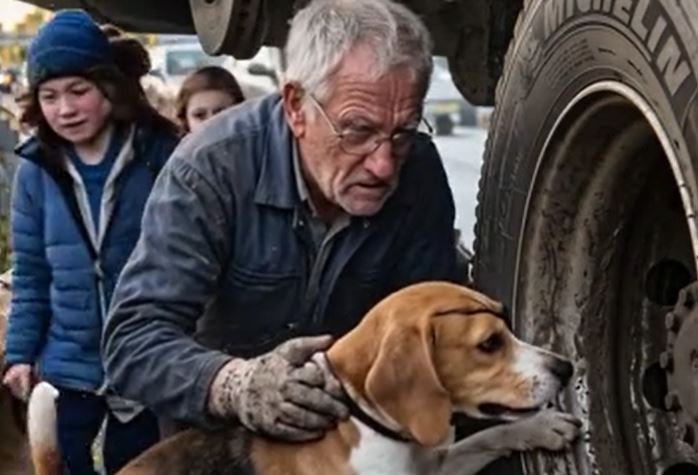
Earl grabbed his dog. He didn’t think. He couldn’t think. He placed Biscuit in the gap — the narrow, terrifying, impossible gap — and he wedged the stop sign behind him, bracing it against the guardrail, creating a triangle of resistance.
Biscuit understood.
He didn’t move. He didn’t squirm. He pressed his body against the bus’s tire, all 22 pounds of muscle and fur and absolute, unbreakable will, and he held.
Earl pressed beside him. His shoulder against the stop sign. His knee screaming. His body shaking. He pushed. Biscuit pushed. Together they became a wedge. A barrier. A living, breathing thing standing between twelve tons and forty feet.
The bus settled.
Not stopped. Not safe. But settled. The back wheels, instead of rolling over the edge, found purchase against the beagle’s body, the stop sign, the old man’s shoulder. The guardrail stopped bowing. The screaming stopped.
Maria opened the door.
The children filed out. Sophie was last. She looked at Earl, at his bleeding knee, his shaking hands. She looked at Biscuit, wedged in the gap, his body pressed against the tire, his cloudy eye closed, his good eye fixed on her.
“Biscuit?” she whispered.
His tail moved. Once.
The fire department arrived. They chained the bus. They winched it back. They pulled Earl and Biscuit from the gap — both of them trembling, both of them refusing to let go until the last child was clear.
The paramedic checked Biscuit. Bruised ribs. Compressed spine. Internal bleeding they would find later. But alive. Standing. Wagging his tail at Sophie while she cried into his neck.
Earl refused the ambulance. He sat on the curb, yellow vest torn, knee wrapped in a bandage that wouldn’t stay, and he held Biscuit in his lap until the vet came.
The school district offered him a job. Official. Paid. Benefits. He turned it down.
“I don’t do it for money,” he said. “I do it because someone has to stand there. And I can’t stand there alone.”
Biscuit died six months later.
Not from the injuries — those healed, mostly. From old age. From a heart that had simply done too much. Earl buried him on the corner of Maple and Birch, in the shadow of the oak tree, where the city finally trimmed the branches and fixed the drainage so the ice wouldn’t form again.
He still stands there every morning. Yellow vest. Hand-me-down sign. An empty space where Biscuit used to sit.
But not empty. Not really.
Because every child who passes — Sophie, now 10, still gap-toothed, still saving the last bite of her granola bar — stops. They place a flower on the small grave. They touch the wooden marker that reads:
“Biscuit. Crossing Angel. He stood so we could walk.”
And Earl stands. He holds his sign. He watches the cars slow down, not because of him, but because of the story. Because of the beagle who weighed 22 pounds and held back 12 tons.
Because of the truth that some gaps are too wide for one person.
But never too wide for love.