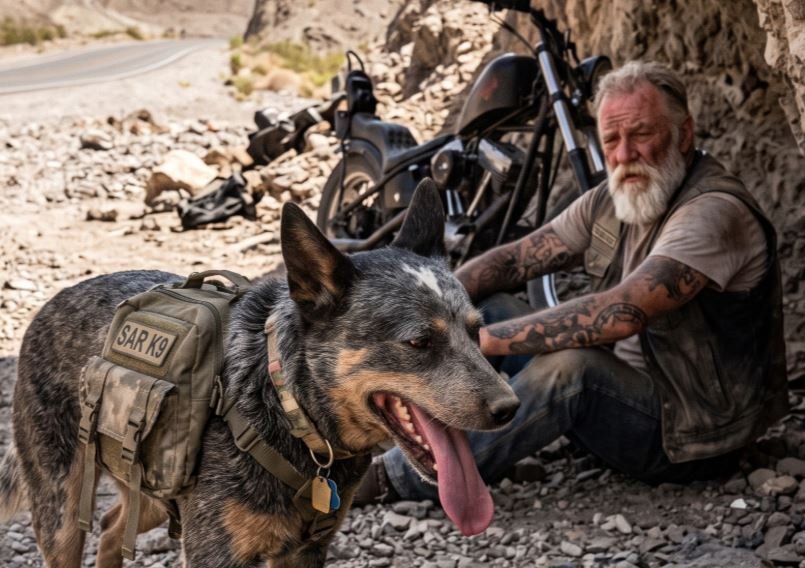
Miles left at dawn.
Cole woke to her absence. The particular disappointment of a man who had allowed himself hope. He sipped water. He waited for the sun to kill him.
She returned at noon.
Not empty. She carried something in her mouth — a torn backpack, olive drab, faded. She dropped it at his feet. It was a SAR emergency kit. Water purification tablets. A signal mirror. An emergency beacon, the kind that transmits on 406 MHz.
Cole stared at it.
“Where did you find this?” he asked.
Miles didn’t answer. She lay down, panting, her three legs trembling. She had carried the pack for miles. On three legs. In 120 degrees.
He activated the beacon.
But he knew the math. Search and Rescue in Death Valley averaged 48 hours for a signal. He had maybe one day of water left. The beacon was hope, but hope was not survival.
Miles left again.
She returned at dusk with a mylar blanket. Crumpled, torn, but intact. She had found it in a wash — from a survey drone that had crashed months ago, from a hiker’s lost gear, from the particular detritus that accumulates in a desert where people die and machines fail.
Day three.
Miles made six trips. Each time she returned with something — a plastic canteen with an inch of stale water. A sun-bleached bandana. A length of paracord from a forgotten campsite. She was scavenging a radius of five miles on three legs, finding what the desert had discarded and bringing it to a man she had known for 36 hours.
Cole understood.
Not her. Himself. The particular realization of a man who had spent his life taking things apart and was now, finally, understanding how they fit together. Miles wasn’t staying with him because she was loyal. She was staying because she was working. Because her particular intelligence was not in guarding — it was in gathering. In solving. In finding what was needed and bringing it back.
He had read her file.
Not literally. But he knew the type. SAR dogs who washed out for “failure to stay.” Dogs who left the victim and returned to handlers, who wandered during searches, who were labeled undisciplined, unfit, dangerous to the mission.
They weren’t failing.
They were innovating. They were gathering resources, expanding the search radius, doing what their handlers couldn’t. But the program didn’t understand. The program wanted dogs who sat by the victim and barked. Miles had been fired for being too smart.
Cole built her a splint.
Using the multi-tool. A piece of his bike’s fender strut. His leather belt. He immobilized her broken leg — gently, carefully, the particular craftsmanship of a man who had spent thirty years making metal obey. She let him. She didn’t flinch. She just watched, nose working, as if assessing his work.
It was good.
She stood on it. Tested. Then she left again.
Day four.
The beacon was active. The water was holding. But Miles had stopped returning as quickly. Her trips took longer. She came back limping worse, her good legs shaking, her body running on the particular fuel that dogs burn when they have decided that stopping is not an option.
At dusk, she didn’t return.
Cole waited. He called — uselessly, his voice cracking in the dry air. He waited through the night, the particular horror of a man who has been saved and then abandoned, who doesn’t understand that Miles was not leaving him but leading something back.
She returned at dawn on day five.
Not alone.
She carried a ranger’s hat in her mouth. A Stetson, tan, with a badge on the band. She dropped it at Cole’s feet. Then she turned. She ran — three-legged, splinted, desperate — back the way she had come.
She stopped. Looked back.
The particular posture of a dog saying follow. Now. While you can.
Cole crawled.
He couldn’t walk. But he could crawl. He dragged himself across the gravel wash, following Miles, following the particular faith that she had earned. She moved ahead of him, slowly, checking, the particular patience of a creature who understood his limitations and refused to leave him behind.
They reached the ridge.
A Park Service truck. Two rangers. One holding binoculars, looking the wrong direction. Miles barked — once, twice, the particular bark she had been trained to suppress, the sound that meant found. Here. Now.
The rangers turned.
They saw Cole. They saw Miles. They saw the particular impossibility of a broken man crawling through Death Valley, following a three-legged dog who had found them five miles from the beacon’s coordinates.
Part 3: The Builder
Cole didn’t go to Vegas.
He went to the hospital. Surgery on his ankle. Physical therapy. The particular bureaucracy of recovery that he endured because Miles was waiting — in a kennel, under observation, the particular limbo of a dog with no owner and a failed career.
The SAR program that had washed her out came to claim her.
Not to rehire. To rehome. To the particular machinery of government animals who have outlived their usefulness. Cole refused.
“She’s not yours,” he said. “You fired her. I adopted her.”
They threatened. Paperwork. Jurisdiction. The particular language of organizations that believe they own what they discard. Cole hired a lawyer — pro bono, from a veterans’ group, the particular network of ex-cons and soldiers who understand that loyalty is earned, not assigned.
He won.
Not in court. In the press. The story — failed SAR dog saves ex-con biker in Death Valley — hit the particular vein of viral that the algorithm favors. 94 million views. The SAR program backed down. They issued a statement. They revised their training protocols. They admitted, quietly, that Miles had never been failing. She had been evolved.
Cole built her a sidecar.
Not a basket. A custom rig. Suspension. Padding. Climate-controlled vents. He used the chopper that had nearly killed him — the frame was bent, the engine seized, but the particular metal was good. He cut it, welded it, shaped it into a sidecar that cradled Miles’s body, that supported her bad leg, that let her ride with her head into the wind without pain.
She rode with him.
Not as a passenger. As a partner. Nose to the wind, ears back, the particular joy of a creature who had been told she was broken and had proven, in the particular mathematics of survival, that she was simply built for a different equation.
They rode to Vegas.
Not for the show. Just to finish. To complete the particular journey that had been interrupted. They rode down the Strip — Miles in her sidecar, head high, the particular celebrity of a dog who had saved a man and been saved in return.
Cole still builds bikes.
But now he builds sidecars too. For veterans with PTSD dogs. For diabetics with alert dogs. For the particular partnerships that the world doesn’t understand — the ex-con and the reject, the broken man and the failed dog, the particular combination that works because it has been tested in the only laboratory that matters.
Desert. Heat. Distance. Death.
Miles is 9 now.
Gray-muzzled. The bad leg is fused, stiff, but she still puts weight on it. She still rides. Still puts her head into the wind. Still smells the world with the particular intensity of a dog who knows that survival is not about strength — it is about gathering. About returning. About refusing to stay in the place where you were left.
Cole tells her story.
Not for views. For the particular reason that survivors tell stories — because the telling is proof of living. He tells it at bike shows. At veteran centers. At the particular gatherings of broken people who need to know that failure is not final, that rejection is not truth, that the particular dog who runs away might be running for something, not from it.
He ends every telling the same way.
With his hand on Miles’s head. With her leaning into his palm. With the particular weight of a creature who has earned her place in the world not by obeying, but by refusing to stop.
“She didn’t save me by staying,” he says. “She saved me by leaving. By finding what I needed. By bringing it back. By knowing that sometimes the only way to rescue someone is to go get help they don’t know exists.”
He looks at the veterans. At the ex-cons. At the particular audience of people who have been told they are broken, failed, unfit.
“She was fired for being too independent,” he says. “I was fired for being a thief. Turns out we just needed the right job. And the right partner.”
Miles wags her tail.
Once. The particular wag of a dog who doesn’t need applause. Who just needs the wind, and the road, and the particular knowledge that she is exactly where she belongs.
Riding shotgun.
On three legs.
Into the desert that tried to kill them both.