Four seconds.
That’s how long an elevator takes to fall fourteen floors when the brakes fail. Harold had time to think one thing: Margaret, I’m coming.
Buster had time to do something else.
He didn’t think. Dogs don’t think in emergencies. They react in the language their bodies know best.
Buster lunged.
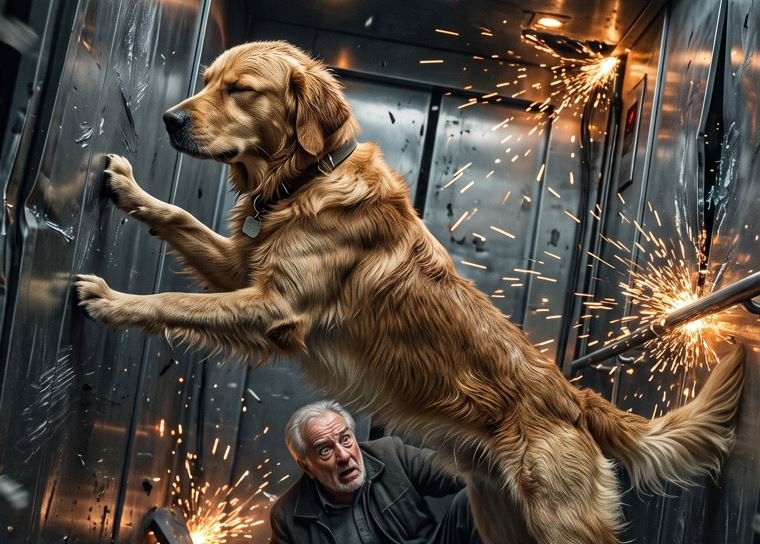
Not at the door. Not at the buttons. At Harold. He hit the old man’s chest with 75 pounds of golden retriever, knocking him backward into the corner. He wedged his body between Harold and the floor, bracing his front legs against the front wall, his back legs against the side wall, making himself a living shock absorber.
Harold’s head hit the padded corner rail. His arms wrapped around Buster’s ribs. He felt the dog’s muscles lock, every fiber tensing, every instinct screaming hold, hold, hold.
The elevator hit the bottom.
The impact wasn’t a crash. It was a compression — metal folding into metal, the floor bowing upward, the ceiling dropping down. The lights exploded in sparks. Dust filled the air like a held breath.
Harold’s spine compressed against the corner. His hip struck the railing. Pain, white and electric, shot through his pelvis.
But he didn’t hit the floor.
Buster took the impact. His front legs buckled. His shoulders absorbed the force that would have shattered Harold’s skull, his ribs, his everything. The dog’s body compressed like a spring, his chest striking Harold’s, his weight becoming a cushion that distributed the blow across the old man’s torso instead of letting it concentrate in any single point.
They lay in the dark.
Harold couldn’t breathe at first. Not from injury. From the weight of a dog on his chest. He felt Buster’s heartbeat — fast, terrified, but beating. He felt wetness on his face. Not blood. Drool. Buster’s nose was pressed against his cheek, checking, always checking.
“Buster,” Harold whispered.
The tail thumped once against the bent metal wall.
It took the fire department 23 minutes to cut through the doors. They expected bodies. They found an old man with a broken hip and a dog who wouldn’t let go.
Buster had wedged himself so tightly around Harold that the rescuers couldn’t separate them. Every time they tried to lift the dog, he growled. Not aggressive. Territorial. This is mine. I kept him alive. You don’t get to take him.
They sedated Buster to get him out. Harold fought them. He fought the paramedics. He fought the pain in his hip. He only stopped fighting when they promised him the dog would be at the same hospital.
They lied. Buster went to the emergency vet across town.
Harold had surgery at 3 PM. Hip replacement. He woke up at 6 PM and demanded his dog. The nurses said no. He threatened to walk out. They pointed out he couldn’t walk. He threatened to crawl. They called the vet.
The vet said Buster had two crushed vertebrae. A collapsed lung. Internal bleeding they were still fighting to control. The impact had compressed his spine like an accordion. He shouldn’t have survived. Dogs don’t survive elevator drops from fourteen floors.
But he had made himself a bridge. A cushion. A sacrifice that somehow, impossibly, held.
Harold checked himself out against medical advice. He took a cab to the vet. He sat on the floor of Buster’s kennel, his new hip screaming, his old heart breaking, and he held his dog’s paw until morning.
Buster lived.
Not well, not at first. He would never walk without a limp. He would never climb stairs. He would never again thump his tail against the brass elevator railing at 7:16 AM.
But he lived.
They moved to a ground-floor apartment. Harold sold the Art Deco building. He couldn’t look at elevators anymore. He took the stairs, slowly, Buster hobbling beside him, both of them moving like old soldiers who had survived a war nobody else knew about.
Every morning at 7:15, they walk to the corner bakery. Buster gets a scrambled egg. Harold gets coffee. They sit on the same bench. They watch the same pigeons.
And every time an elevator door dings nearby, Buster’s ears twitch. He doesn’t flinch. He doesn’t cower. He just presses closer to Harold’s leg, his body a warm, living reminder that some falls don’t have to be final.
Harold wrote a letter to the building management. He didn’t sue. He didn’t demand. He just wrote:
“Your elevator tried to kill me. My dog said no. Fix your cables. Someone else’s Buster might not be as stubborn.”
They installed a new elevator. Modern. Safe. Boring.
Harold never rode it.
On Buster’s 12th birthday, Harold threw him a party. Just them. A scrambled egg cake. A new bed that cost too much. And a framed photo on the wall — the last picture taken in the old elevator, two weeks before the fall. Harold and Buster, both looking at the camera, both smiling in the way that only old friends can.
The frame is brass. Like the old railing.
Buster sleeps beside it now, his white muzzle resting on his paws, his breathing slow and steady. Harold sits nearby, reading, occasionally reaching down to touch the dog’s ear.
They don’t talk about the fall. They don’t need to.
Some bonds don’t require words. Some heroes don’t need capes.
Some dogs just need to love you enough to become your landing.