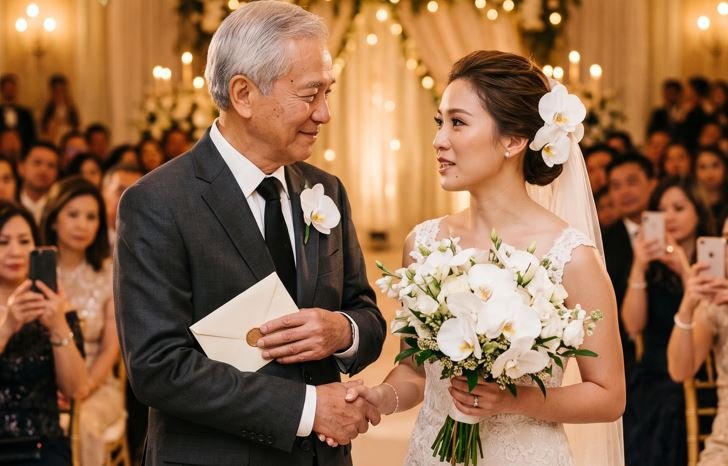
Everyone at the Hartwell Estate that afternoon believed they understood exactly what kind of wedding they were attending. Rosalind Cole was twenty-seven, striking, and visibly out of place among the old money crowd in her simple ivory gown. Edmund Hartwell was eighty-two, the reclusive founder of a shipping empire worth more than most small countries, and the groom nobody had expected to marry again after burying two wives and outliving most of his own board of directors.
The gossip had started the moment the engagement was announced six months earlier. Rosalind worked as a hospice music therapist — she played piano for dying patients, mostly elderly ones, for a modest hourly rate that barely covered her studio apartment in the city. She had met Edmund at St. Adeline’s, where he’d been visiting an old business partner in his final weeks. She played “Clair de Lune” in the hallway one evening, not realizing anyone was listening. Edmund had been listening for forty minutes.
“You didn’t stop when you saw me,” he told her later. “Everyone stops when they see me.”
“I didn’t know who you were,” she said.
“That,” he replied, “is exactly why I’m still standing here.”
Their courtship had been quiet, almost old-fashioned — dinners in his modest downtown apartment rather than his estate, long walks where he asked about her music and rarely mentioned money. Rosalind’s friends were thrilled for her, if a little disbelieving. Her mother was openly worried.
“Do you know what his family will say?” her mother asked the week before the wedding. “Do you know what they’ll assume about you?”
“I know what everyone assumes,” Rosalind said. “I stopped caring the day he asked me to marry him instead of just dating him quietly and keeping it out of the papers.”
Edmund’s family — two adult children from his first marriage, a handful of cousins who’d circled his fortune for decades — had made their disapproval clear from the moment the engagement was announced. His son, Prescott, had gone so far as to hire a private investigator to look into Rosalind’s background, findings which turned up exactly nothing except unpaid student loans and a spotless work history. That hadn’t stopped the whispers. At the rehearsal dinner, Prescott had raised a toast so thinly veiled in its insult that half the room had gone silent with secondhand embarrassment.
“To Rosalind,” he’d said, glass raised, “who found the one man in this city generous enough to solve all her problems at once.”
Rosalind had smiled through it. Edmund had not. He’d stood, quietly, and simply said, “Sit down, Prescott,” in a tone that ended the toast immediately.
None of that history was visible on the wedding day itself. The ceremony was held in the estate’s rose garden, string quartet playing, two hundred guests in their finest, Edmund standing at the altar in a suit tailored decades of practice ago to fit a man who still, at eighty-two, stood remarkably straight.
Rosalind walked down the aisle alone — her father had passed years earlier, and she’d refused to let anyone else fill that role symbolically. She caught Edmund’s eyes halfway down the aisle and felt, for just a moment, the entire crowd disappear.
The vows themselves were traditional, unremarkable, exactly what everyone expected. It was what happened after the vows that no one in that garden would forget.
Instead of reaching for the rings, Edmund reached into his jacket and withdrew a plain cream envelope, sealed, with nothing written on the front.
“Before you say ‘I do,'” he said, loud enough for the microphone to carry across the garden, “I need you to open this. Not after the wedding. Now.”
Rosalind laughed nervously, glancing at the crowd. “Right now? In front of everyone?”
“Especially in front of everyone,” Edmund said. “Because everyone in this garden has an opinion about why you’re marrying me. I’d like them to hear the truth at the same time you do.”
A murmur rippled through the guests. Prescott, seated in the second row, straightened sharply, his jaw tightening. Rosalind’s hands trembled slightly as she broke the seal.
Inside was a single typed page. She began to read, and her face changed with every line — confusion first, then something closer to disbelief.
The letter was not a prenuptial agreement, as half the garden had assumed it would be. It was a full, notarized disclosure. Edmund Hartwell was not, as his public company profile suggested, worth the eleven-figure sum reported in business magazines. Three years earlier, following a catastrophic and quietly settled fraud lawsuit involving a former business partner, the bulk of his personal fortune — nearly eighty percent of it — had been transferred into an irrevocable charitable trust, funding hospice and palliative care programs across the country, the very kind of program where he and Rosalind had met. What remained in his personal accounts was still comfortable, but a small fraction of what the world believed. The mansion they were standing in was owned by the trust, not by him. He lived in it, by the trust’s permission, as a kind of caretaker and public face for its mission.
“I let the world keep believing the old number,” the letter read, in Edmund’s own careful handwriting beneath the typed disclosure, “because it protected the foundation from scrutiny while it got established, and frankly, because it kept away people who were only interested in what I used to have. I needed to know, before I let you marry me, whether you were one of those people. I already know you’re not. But I wasn’t going to let you find out what you were actually marrying without saying it myself, out loud, to everyone who has spent six months assuming they knew exactly why you said yes.”
Rosalind looked up from the letter, and the entire garden was silent, waiting.
“You gave away most of your fortune,” she said slowly, “to hospice programs. Programs like the one where we met.”
“Three years before I met you,” Edmund said. “You didn’t fall in love with a fortune, Rosalind. You fell in love with what was left after I gave it away. I needed everyone here — especially my son — to understand that difference before we exchanged rings.”
Prescott had gone pale in the second row. Rosalind’s mother, several seats away, had both hands pressed to her mouth.
For a long moment, Rosalind said nothing at all. Then she folded the letter carefully, tucked it into her bouquet, and looked back up at Edmund with an expression that had shifted from shock into something steadier.
“You could have told me this privately,” she said. “Weeks ago. Why do it here, like this?”
“Because privately, only you would have known the truth,” Edmund said. “And I wanted the people who spent six months deciding what kind of woman you were to hear it directly from me, at the exact moment they expected to be proven right.”
Rosalind laughed — a real laugh, surprised out of her, cutting through the tension in the garden like sunlight through clouds. “You’re insufferable,” she said.
“I’m eighty-two,” Edmund said. “I’ve earned the right to be insufferable exactly once at my own wedding.”
The officiant, visibly relieved, cleared his throat and asked if they were ready to continue. Rosalind nodded, still holding the folded letter against her bouquet, and slid the ring onto Edmund’s hand herself.
“I do,” she said, “and for the record, I would have said it either way.”
“I know,” Edmund said quietly. “That’s exactly why I finally told you.”
Prescott left before the reception began. Nobody stopped him. Rosalind spent the evening dancing badly with a man forty years past his prime, laughing every time he stepped on her hem, surrounded by guests who — for the first time all season — seemed to be looking at her rather than at what they’d assumed about her.
Years later, when people asked Rosalind what it was like marrying a man everyone believed was one of the wealthiest people in the country, she told them the truth: she hadn’t. She’d married a man who’d already given the wealth away, kept only enough to be comfortable, and spent the rest of his life quietly funding the exact kind of care that had once let two strangers meet in a hospital hallway over an unfinished piece of Debussy. The mansion eventually passed fully to the trust when Edmund died, peacefully, nine years later, with Rosalind at his side and a small upright piano — his final gift to her — in the corner of their bedroom.
She still plays it every evening. Not because anyone’s listening.
But because, once, someone had.
THE END