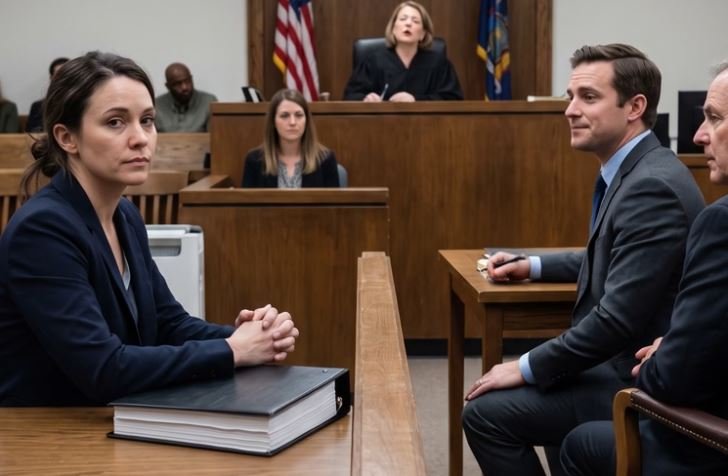
Rachel Carter had learned, over the fourteen months since her divorce was finalized, that the easiest way to survive a custody battle was to stop arguing and start documenting.
It hadn’t started that way. In the beginning, she’d tried to reason with Marcus the way she always had — calm phone calls, calendar invites for pickup times, polite texts asking whether he’d remembered their son Eli’s asthma inhaler on his weekends. Marcus had a way of making every disagreement sound like it was her fault, a talent she recognized now had been present their entire marriage and that she’d simply mistaken, for years, for confidence.
It was her sister, a paralegal at a mid-sized firm downtown, who’d finally sat her down over coffee six weeks after the divorce was finalized and said the words that changed everything.
“Stop explaining yourself to him,” she said. “Start building a file. Judges don’t care who sounds more reasonable in an argument. They care what’s on paper.”
So Rachel started building a file.
Every pickup and drop-off got a timestamped photo — Eli’s backpack by the door, the clock on the microwave visible in the background. Every school event got a printed program with her name on the sign-in sheet. Every therapy session Eli attended for the anxiety that had crept in after the divorce got a dated summary from his counselor, requested in writing, filed the same week it was received. When Marcus canceled his weekends — which happened with increasing frequency over that first year, always with a plausible excuse, always followed by radio silence for days — she saved the texts. When he was late for pickups, she logged the exact minute he arrived. None of it was dramatic. Most of it was mundane, the paperwork trail of an ordinary, exhausted single mother going to work, packing lunches, showing up to piano recitals alone.
She never once mentioned the file to Marcus. There didn’t seem to be a point. He’d made his opinion of her clear the day he moved out — that she was, in his words, “always making things harder than they needed to be.” She’d stopped expecting him to see her differently. She just kept building the file, quietly, the way you keep an umbrella in the car during a dry season — not because you expect rain, but because you’ve learned not to be caught without one.
The custody hearing had been scheduled for months, ever since Marcus filed a motion to modify their agreement, requesting primary custody on the grounds that Rachel’s “erratic and uninvolved parenting” made her an unsuitable primary guardian. Rachel had read the filing twice, sitting at her kitchen table long after Eli was asleep, feeling something cold settle in her stomach that had nothing to do with fear of losing and everything to do with the sheer audacity of the specific words he’d chosen. Erratic. Uninvolved. She’d missed exactly one dentist appointment in fourteen months, rescheduled the same afternoon because of a work emergency she’d documented in an email to her boss with a timestamp two minutes after the original appointment slot.
The courtroom on the day of the hearing was smaller than she’d expected, fluorescent-lit, smelling faintly of old carpet and coffee. Marcus arrived with his lawyer, a sharp, expensive-looking man who projected the kind of easy confidence that Rachel recognized instantly, because it was the same confidence Marcus had always worn like a second skin. Rachel sat at the plaintiff’s table with her own lawyer, a quieter, more methodical woman named Denise Okafor, and the thick black binder Rachel had spent fourteen months building, sitting closed and unremarkable in front of her.
Marcus’s lawyer spoke first, and spoke well. He painted a picture of a mother stretched too thin, distracted, prioritizing work over her son, missing the emotional cues a child needed during a difficult transition. He cited two lates pickups — real, documented, both under ten minutes, both logged in Rachel’s own file with the reasons attached. He implied, without quite saying it outright, that Eli’s anxiety was a symptom of instability at home rather than the ordinary fallout of watching his parents’ marriage end.
“Fourteen months,” the lawyer said, turning slightly toward Rachel’s table for emphasis, “of a mother who has been, by her own ex-husband’s account, largely absent and uninvolved in the consistent, structured care this child needs.”
The judge, a woman in her fifties with sharp, patient eyes, turned to Rachel’s table. “Ms. Carter, your ex-husband’s counsel characterizes the past fourteen months as a period of absence and inconsistency on your part. Would you like to respond?”
“I would, Your Honor,” Rachel said, and her voice came out steadier than she expected. “I have something for the court.”
She opened the binder — not dramatically, not for effect, simply the way you’d open a filing cabinet — and slid it, along with three photocopied sets prepared in advance, across to the bailiff for the judge, opposing counsel, and the court record.
Denise walked the court through it methodically. Timestamped photographs of every single pickup and drop-off across fourteen months, cross-referenced with a shared calendar Rachel had exported showing exactly which parent had which day. Written confirmations from Eli’s counselor, requested and filed the same week as each session, documenting steady improvement rather than instability. School sign-in sheets showing Rachel present at eleven of twelve events over the period; Marcus present at two. A log of the handful of times Marcus had canceled his own scheduled weekends, with his own text messages as the source — “can’t do it this weekend, something came up,” sent four separate times with no further explanation, no rescheduled makeup time ever proposed by him.
Marcus’s lawyer flipped through his copy with visibly slowing hands. Marcus himself leaned toward him, his earlier composure cracking at the edges. “That’s not — where did she even get all that?” he whispered, loud enough that Rachel heard it from across the aisle.
“She got it,” Denise said calmly, without waiting to be asked, “the same way any responsible parent documents fourteen months of raising a child largely on her own — by showing up, and keeping a record of showing up, every single time.”
The judge spent a long moment reviewing the binder in silence, the only sound in the room the faint hum of the fluorescent lights overhead. When she finally looked up, her expression had shifted from neutral to something considerably harder.
“Counsel,” she said to Marcus’s lawyer, “I’d like a moment to review this material more thoroughly before we continue. We’ll take a short recess.”
The recess lasted forty minutes. When the hearing resumed, the tone of the room had changed entirely. Marcus’s lawyer, to his credit, no longer pushed the “uninvolved” characterization; the paper trail had made that argument untenable in a way that no amount of courtroom polish could recover. The judge’s ruling, delivered twenty minutes later, kept the existing custody arrangement fully intact, with a pointed note in the written decision that the motion appeared to have been filed on assertions “substantially unsupported, and in several instances directly contradicted, by the documented record.”
Marcus didn’t look at Rachel on the way out. Eli, waiting in the car with Rachel’s mother in the courthouse parking lot, asked only whether he’d still get to have his regular Tuesday dinner with her, and Rachel told him yes, exactly the same as always, because nothing about their life together was actually going to change — it had simply, finally, been written down where someone else could see it too.
That evening, after Eli was asleep, Rachel sat at the same kitchen table where she’d first read Marcus’s filing months earlier, and closed the binder for what she hoped would be the last time it was ever needed. She didn’t feel triumphant, exactly. Mostly she felt tired, in the specific way that comes after carrying something heavy for a long time and finally being allowed to set it down.
She kept the binder anyway. Not because she expected to need it again.
But because she’d learned, the hard way, not to be caught without proof of who actually showed up.
THE END