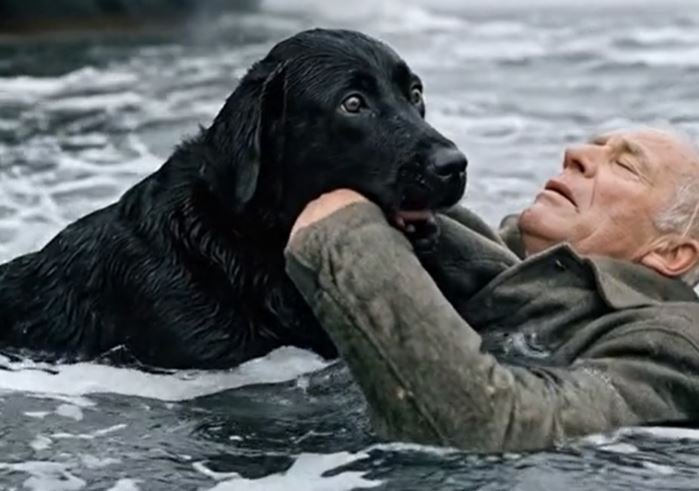
The water was 48 degrees.
Thomas felt it as a fist, not a splash. His lungs seized. His limbs locked. Sixty years of fishing had taught him to swim, but eighty-four years of living had stolen the strength to do it. He flailed. He sank. He opened his mouth to scream and swallowed the sea instead.
Scout hit the water beside him.
The dog’s panic was instant and total. His legs paddled wildly, not swimming but drowning upright. His eyes were wide, white-rimmed, terrified. This was his nightmare made real — the deep, the cold, the sinking.
But the leash was in Thomas’s hand.
And Thomas was sinking.
Scout felt the pull. Felt his owner going down, the weight of winter clothes and old bones dragging him toward the bottom. The dog’s fear didn’t disappear. It transformed. It became something else — something older than instinct, stronger than terror.
He stopped paddling for himself.
He turned. He found Thomas’s arm in the murk. He clamped his jaws around the sleeve — not hard enough to break skin, hard enough to hold. And he swam.
Not well. Not gracefully. His own panic made him clumsy, his strokes uneven, his body fighting the cold. But he swam toward the light, toward the surface, toward the ferry that was already turning, already shouting, already too far.
Thomas was dead weight. Eighty-four years. Wet wool. Heavy boots. A body that had given everything it had.
Scout didn’t let go.
He swam for twenty yards. Thirty. His muscles burned. His lungs screamed. The cold crept into his bones like a thief. He could feel his body failing, his strokes weakening, his grip slipping.
He bit down harder.
The ferry crew threw a line. It missed. They threw a life ring. It floated away. The captain was screaming into the radio, but help was minutes away, and they had seconds.
A deckhand — nineteen years old, summer job, never seen a body before — stripped off his jacket and dove.
He reached them at forty yards. He grabbed Thomas under the arms. He looked at Scout, at the dog’s jaws locked on the old man’s sleeve, at the eyes that said I will die before I let go.
“I got him,” the boy said. “Let go, buddy. I got him.”
Scout didn’t let go.
Not until they were at the ferry’s ladder. Not until three hands had hold of Thomas. Not until the old man’s chest was against the hull and his heart was still beating.
Then Scout released. His jaws opened. His body went limp. He sank.
The deckhand caught him by the collar. Hauled him up like a net full of nothing. Laid him on the deck and pumped his chest — not knowing how, just doing, because you don’t let something like that die.
Scout vomited water. He gasped — a terrible, rattling sound. He stood, shaking, and limped to where Thomas lay.
The old man wasn’t breathing well. But he was breathing. Color was returning to his lips, blue to pink, death to life.
Scout lay down beside him. He rested his head on Thomas’s chest. He listened to the heartbeat. He counted it. One. Two. Three.
When the Coast Guard arrived, they found them like that. Two creatures, soaked and frozen, wrapped in the same blanket. The dog wouldn’t let them separate them. He growled at the medics. He snapped at the stretcher.
Thomas opened his eyes. He couldn’t speak. But he found Scout’s ear with a trembling hand. He held it.
The tail thumped. Once. Wet against the deck.
They spent two days in the hospital. Thomas for hypothermia. Scout for observation — the vet said his heart had strained past its limit, that another minute in the water would have been different.
Thomas didn’t ride the ferry again.
He sold the house. He bought a small cottage on the island — walking distance from Mary’s grave. No more crossings. No more water. Just pine trees and quiet and a dog who still trembled at the sound of waves.
But every morning, Scout walks to the cliff’s edge. He stands there, looking at the water, his body tense, his ears flat. Thomas lets him. He knows what the dog is doing.
He’s remembering.
Not the fear. The choice.
The moment when the deep tried to take everything, and he decided — with frozen muscles and terrified heart — that some leashes are stronger than gravity.
Some Sundays, when the ferry passes in the distance, Scout doesn’t tremble. He just watches. His tail moves. Once. Twice.
And Thomas knows: they’re both still crossing. Just on different water now.