Luis Vega saw the ship from the Galveston causeway. A rusted freighter, half-sunk, listing to port. The María Celeste — someone had painted the name in faded white. Abandoned after Hurricane Ike in 2008. A ghost ship. No one went near it.
Except someone had.
Luis was riding home from the garage when he saw the light. A flashlight beam, moving inside the hull. Then gone. Then a bark. Muffled. Distant. Then nothing.
He turned his bike around.
The deck was rotted. He tested each plank with his boot before putting weight on it. The hatch leading below was open. Water gleamed black in the moonlight. Four feet deep. Tide rising.
He didn’t hesitate. He never did, with water. His abuela used to say he was born during a hurricane in San Antonio, and the rain had claimed him before he took his first breath. Water was home. Even black water. Even freezing water in a rusted ship.
He waded in.
The smell was oil and rust and salt. His boots found the floor — uneven, tilting. He moved by feel, one hand on the wall. The flashlight on his phone cut through darkness.
And then he saw her.
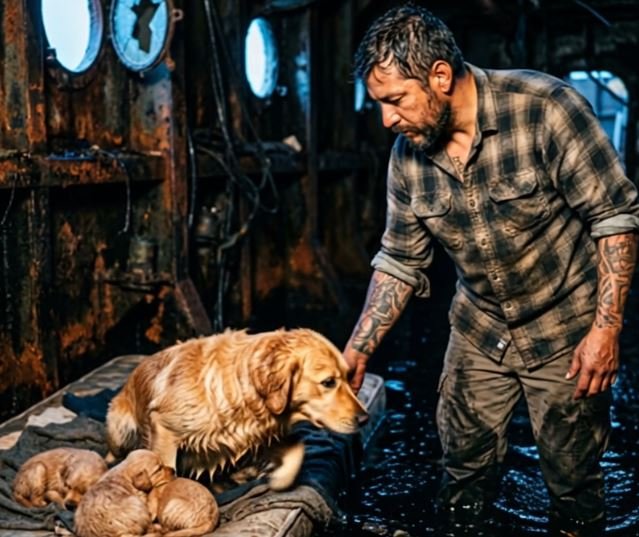
A golden retriever, beautiful and exhausted, lying on a floating mattress in what used to be the crew quarters. Three puppies nursed at her belly. The mattress was soaked at the edges. In another hour, the tide would claim it.
The mother saw him. She didn’t growl. She lifted her head, ears back, and waited. Dogs who have been abandoned learn to read human faces. She was reading his.
“Hey, preciosa,” Luis whispered. “Vamos. Let’s go.”
He reached for the first puppy. The mother watched. He lifted the golden ball of fur above his head, out of the water, and tucked it inside his leather jacket. Warm. Safe. The puppy didn’t cry. Just nestled against his chest.
The second puppy was heavier. Male. His eyes were barely open. Luis cradled him in his left arm, against his heart.
The third puppy was tiny. The runt. Luis held her in both hands, close to his face. She licked his nose. Once. A thank-you in advance.
Then he turned to the mother. She was big. Seventy pounds of wet golden fur. She tried to stand on the mattress, slipped, fell into the water. Paddled to him. Pressed her nose into his outstretched palm.
He didn’t carry her. She swam beside him, her head above water, her eyes never leaving the puppies in his arms. Through the black water. Past the rusted hatch. Up the tilting stairs. Onto the deck.
In the moonlight, he saw the collar. A pink nylon band. And pinned to it, a note in shaky handwriting:
“Can’t feed them. Please help. Her name is Marina.”
Luis sat on the deck, all three puppies in his lap, Marina pressed against his side, and read the note three times. Not angry. Just sad. Someone had loved her enough to name her. Not enough to keep her.
He called Preacher. “I need the trailer. And blankets. And Darlene. And tell Bear to bring food.”
They came at 4 AM. Bear on his Harley. Preacher in the truck. Darlene with her medical bag. They set up a camp on the causeway. Warmed the puppies. Checked Marina — heartworm negative, miraculously. Malnourished but alive.
Luis took Marina home. The puppies — Galveston, Celeste, and Little Luis — all found homes with crew members.
Every full moon, Luis rides to the causeway. Looks at the María Celeste, still listing, still rusting. And he remembers:
Some people leave dogs to sink.
Bikers learn to swim.