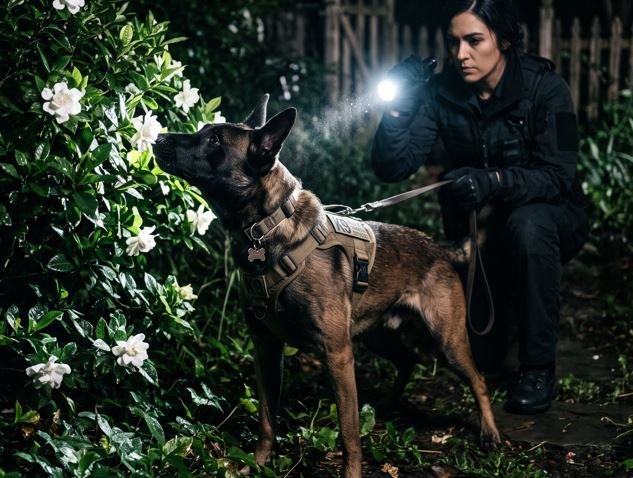
Diana broke.
Not from the evidence. Not from the handkerchief. From the dog.
From Cipher sitting at her feet, nose to her shoes, reading her history in scent. From the particular judgment of a creature who cannot be lied to, who cannot be manipulated, who knows only the truth that bodies tell.
“There was a night,” Diana said.
6 months ago. Before the murder. Before the poison. Before the careful plan that Diana had constructed to save her company, her legacy, her life.
Elena had a nosebleed. Not from injury. From stress. From the particular pressure of running a company, of maintaining a marriage, of hiding an affair that had lasted 3 years.
An affair with Diana.
Not Marcus. Not the tennis instructor. That was cover. That was distraction. That was the particular misdirection that Elena had constructed to hide the truth — that she loved her business partner, that they were together, that the company they had built was also the relationship they could not acknowledge.
The handkerchief was from that night.
Elena bleeding. Diana holding her. The gardenia in Elena’s hair mixing with Diana’s Midnight Orchid. The intimacy of scent. The particular chemistry of two bodies that had been close. Too close. Close enough to leave traces that 6 months could not erase.
They fought that night.
Elena wanted to leave Richard. To come out. To be public. To risk everything for truth. Diana refused. The company. The shareholders. The particular world they had built that would collapse if the founder’s marriage ended in scandal.
Elena threatened.
To expose everything. To sell her shares. To destroy what they had built. To be free, finally, completely, at the cost of everything Diana loved.
Diana planned.
Not immediately. Not passionately. Coldly. Carefully. The particular calculation of a person who has been backed into a corner and sees only one way out.
She learned about poison.
Not exotic. Not traceable. Just… untraceable. A compound that mimicked heart failure. That left no evidence. That would allow Elena to die in her sleep, peacefully, naturally, with no questions asked.
She administered it over months.
Small doses. In Elena’s tea. In her wine. In the particular rituals of their continued affair — the secret meetings, the hidden room, the gardenia bush outside Elena’s window where Diana would climb and Elena would wait.
The final dose was at the dinner party.
Diana’s alibi was constructed. She left early. She went home. She called a friend. She was seen. She was safe.
But she had touched the wine glass.
Not Elena’s. Her own. And in touching it, she had left trace evidence. Not enough for conviction. Not enough for arrest. Just enough for suspicion. Just enough for a detective who was stuck and desperate and willing to follow a dog’s nose to a gardenia bush.
Cipher solved it.
Not with evidence that would hold in court. Not with testimony that a jury would believe. But with scent. With the particular truth that noses know and humans forget.
Diana was arrested.
The case was circumstantial. The handkerchief was old. The perfume trace was minimal. But Diana confessed. Not to the police. To herself. To the particular guilt that she had carried for 6 months, that had grown in her like the poison she had fed Elena, that had finally found its voice in the presence of a dog who could not be lied to.
She told Vera everything.
The affair. The fight. The plan. The particular coldness of a murder that was also a love story. The gardenia bush. The handkerchief. The scent that had betrayed her — not Elena’s scent, but her own, mixed with Elena’s, buried in soil and memory and the particular chemistry of guilt.
Cipher was there.
In the room. At Vera’s feet. Nose to the air. Reading the particular scent of confession — relief, despair, the particular release of a secret that has been held too long.
He didn’t wag his tail.
He just sat. Present. Witness. The particular judgment of a creature who understands that truth is not always justice, and justice is not always truth, but scent — scent never lies.
Part 3: The Handler
Vera adopted Cipher.
Not officially. Not through paperwork. Just… took him home. From the gardener, who was too old to care for a dog with too much energy and too little obedience. From the shelter, where he would have been returned again — “too independent,” “follows his nose, not commands.”
She didn’t train him.
Not in the way that police dogs are trained. Not in commands and protocols and the particular machinery of law enforcement. She just… lived with him. Walked with him. Let him sniff what he wanted to sniff, follow what he wanted to follow, be the particular creature he was meant to be.
He solved three more cases.
Not officially. Not in court. Just… found things. A murder weapon buried in a park. A body in a lake. A child who had wandered into the woods and couldn’t find her way home. Each time, Cipher’s nose leading, Vera following, the particular partnership of a detective who had learned that evidence is not always in fingerprints and a dog who had learned that truth is always in scent.
She didn’t film it.
Not like the viral stories. Not for views. Not for the particular machinery of internet fame. She just… did her job. With a dog who did his. In the particular anonymity of a city that didn’t know their names.
But the Elena’s case became famous.
Not because of Vera. Because of Cipher. Because someone — a reporter, a blogger, a person with a phone — had filmed the moment in the interrogation room. The dog entering. The sniffing. The confession. The particular magic of a creature who could smell guilt.
The video went viral.
100 million views. The algorithm — that mysterious, merciless god — had found its offering. A dog. A detective. A killer. The particular thriller that the internet loves — true crime, but with a twist, but with heart, but with a happy ending that wasn’t happy at all.
Vera hated it.
Not the fame. The simplification. The reduction of a complex case to “dog smells killer.” The particular cruelty of the internet that takes tragedy and makes it entertainment.
But Cipher didn’t care.
He just sat. At her feet. Nose to the air. Reading the particular scents of a world that was full of guilt and innocence, truth and lies, the particular complexity that humans created and noses could cut through.
He was 8 when he died.
Not suddenly. Slowly. The particular decline of a working dog who had worked too hard, smelled too much, processed too many chemicals in a world that was full of poison. His nose failed first. Then his legs. Then his particular independence that had made him who he was.
Vera held him.
In the vet’s office. In her arms. Saying the particular words that she had never said to a human partner, that she had only learned to say because of a dog who had taught her that love is not complicated — it is just presence, just attention, just being there.
“Good boy,” she said. “You found everything. You can rest now.”
His tail thumped once.
Then stopped.
She buried him beneath a gardenia bush.
Not Elena’s. A different one. In her own backyard. Where the white flowers bloomed every summer and the scent reminded her — not of guilt, not of murder, but of truth. Of the particular clarity that noses know and hearts forget.
She still solves cases.
Without Cipher. With evidence. With fingerprints. With DNA. With the particular machinery of justice that processes crime scenes and produces convictions.
But sometimes — at a scene, in a room, in the particular moment when a suspect is lying and she can’t prove it — she closes her eyes. She breathes. She remembers.
And she knows.
Not with evidence. With scent. With the particular memory of a dog who taught her that truth is always there, always available, always waiting to be found — if you are willing to follow your nose, if you are willing to be independent, if you are willing to be the particular creature you were meant to be.
Cipher stays.
Not in the gardenia bush. In her. In the way she works. In the way she trusts her instincts. In the particular independence that she had lost and found again through a dog who followed his nose and solved a murder that humans couldn’t crack.
He stays.
And every summer, when the gardenia blooms, she sits beneath it. She smells the white flowers. She remembers Elena. Diana. The handkerchief. The particular tragedy of a love story that became a murder story that became a story about a dog who could smell what no one else could smell.
She remembers.
And she waits.
For the next case. For the next scent. For the particular moment when the world goes wrong and someone needs to follow their nose to the truth.
Cipher would have found it.
She will too.