The facility was in Punjab.
Not far from Aamir’s hometown. Not close enough to matter. A compound surrounded by wire, filled with the particular sounds of dogs who had known war and were now expected to know peace. Barking. Whining. The particular chorus of creatures who had lost their purpose and didn’t know how to find new ones.
Zarrar was K9-7 again.
Not Zarrar. Not Brave. Just a number. A asset. A piece of equipment that had malfunctioned — too attached, too grieving, too unwilling to perform for a new handler. The evaluation was clear: PTSD. Non-deployable. Recommend retirement or euthanasia.
Hassan found out.
Not through official channels. Through a friend. Through the particular network of soldiers who take care of their own, even when their own are dogs, even when the system has decided that care is too expensive, too complicated, too human for a creature that the military considers equipment.
He drove to Punjab.
Not authorized. Not approved. Just… went. In uniform. With papers that he had forged, that he had stolen, that he had created through the particular ingenuity of a soldier who has learned that the system doesn’t always work and sometimes you have to work around it.
He found Zarrar in a cage.
Not small. Not cruel. Just… a cage. Concrete floor. Metal bars. A water bowl. A food bowl. The particular emptiness of a space that holds a creature but doesn’t hold his heart.
Zarrar didn’t react to his presence.
Not at first. Not with the particular excitement that dogs show when they know a person. He just sat. Nose to the wind — or to the gap beneath the cage door, the particular current of air that carried scents from outside, from freedom, from a world that didn’t know he existed.
Hassan knelt.
He put his hand through the bars. He didn’t grab. He didn’t pull. He just… offered. Palm up. Fingers loose. The particular posture of a person who is asking, not demanding.
Zarrar sniffed.
Once. Twice. The particular assessment that noses make — who is this, what do they want, do they carry the scent of my person, of my war, of my particular world that has ended and cannot be rebuilt.
He smelled Aamir.
Not on Hassan. On Hassan’s uniform. On his boots. On the particular fabric that had been in the same convoy, the same compound, the same air that held the ghost of a soldier who had died 48 hours before going home.
Zarrar’s tail moved.
Once. Hesitant. Testing. Then again. Then a third time. The particular wag of a dog who has found something that matters in a world that has taken everything.
Hassan opened the cage.
Not with a key. With bolt cutters. At 2 AM. In the particular darkness that covers theft, rescue, the illegal transfer of military property into civilian hands. He clipped the leash — not the military one, a new one, blue, soft, the particular color of a life that was not war.
Zarrar walked out.
Not ran. Not celebrated. Just walked. Out of the cage. Out of the compound. Into Hassan’s truck. Into the particular future that Hassan had planned without permission, without guarantee, without any certainty that it would work.
They drove to Aamir’s hometown.
Not to the base. Not to the facility. To a village that Hassan had never seen, that existed in his mind only through Aamir’s stories — the mango tree, the well, the particular house where a mother waited for a son who would not come home.
The mother was named Fatima.
She was 67. She had received the letter. The flag. The particular condolences of a nation that sends its sons to war and brings them back in boxes. She had buried Aamir in the village cemetery, beneath the mango tree, in the particular earth that had raised him.
She didn’t know about Zarrar.
Not until Hassan knocked on her door. Not until he stood there, in uniform, with a dog on a blue leash and a story that he didn’t know how to tell. Not until Zarrar — K9-7, Brave, the particular creature who had refused to let medics take his person — smelled the air and found, in the particular scent of a house that had held Aamir’s childhood, something that made him pull toward the door with a force that Hassan had never felt before.
Fatima opened the door.
She saw the uniform first. The particular fear that mothers feel when soldiers appear unexpectedly — has something else happened, is there more bad news, has the universe decided that one death is not enough.
Then she saw the dog.
Black and tan. Scarred muzzle. Eyes that held the particular patience of a creature who has seen too much and still hopes. Who has lost everything and still searches. Who has learned that love is not about keeping but about finding, again and again, even when the finding hurts.
Zarrar sat.
Not because he was commanded. Because he understood. Because the particular scent of this house — Aamir’s house, Aamir’s mother, Aamir’s particular origin — was the closest thing to Aamir himself that he would ever find again.
He looked at Fatima.
She looked at him. At the scar. At the eyes. At the particular posture of a dog who was waiting for something that she couldn’t give him, that no one could give him, that existed now only in memory and the particular chemistry of love.
“He wouldn’t leave him,” Hassan said.
Not eloquently. Not completely. Just… the truth. The particular truth of a war that takes sons and gives nothing back, that breaks dogs and calls them equipment, that expects mothers to bury their children and go on.
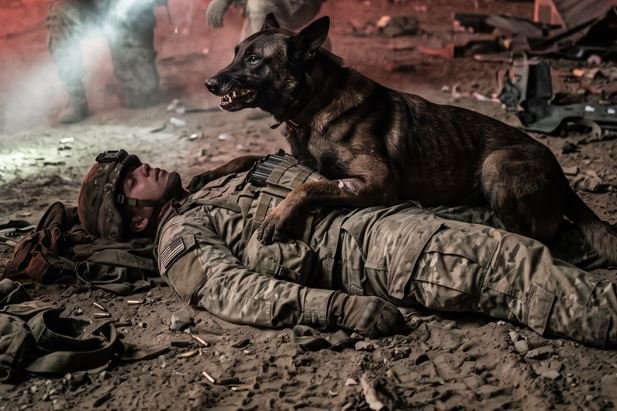
“He lay on Aamir’s body. For four hours. He wouldn’t let us take him.”
Fatima didn’t speak.
She knelt. On the threshold of her house. In the particular dust of a village that the world had forgotten. She reached out. Her hand — old, worn, the particular hands of a mother who has raised a son and buried him — found Zarrar’s head.
He pressed into it.
Not aggressively. Not desperately. Just… pressed. The particular weight of a creature who has found, in the scent of a mother, the ghost of a son. Who has learned that love is transmitted through touch, through smell, through the particular presence of someone who carries, in their pores, in their breath, in their very existence, the person you have lost.
Fatima wept.
Not for Aamir. Not only for Aamir. For Zarrar. For the particular grief of a dog who had no words for his loss, no ritual for his mourning, no particular understanding of why the person he loved had disappeared and left him with a world that didn’t know his name.
She took him in.
Not officially. Not through paperwork. Just… opened her door, opened her home, opened her particular heart that had been broken and was still somehow capable of holding more.
Zarrar became her dog.
Not Aamir’s replacement. Not a memorial. Just… present. In the house. In the village. In the particular routine of a life that continued because it had to, because there was no alternative, because the particular courage of survivors is not in choosing to live but in refusing to die.
He walked to Aamir’s grave every morning.
Not because he was commanded. Because he smelled it. Because the particular scent of his person — buried, decomposed, transformed into the particular chemistry of earth and memory — was still there, still detectable, still real in a way that nothing else was real.
He would sit. For hours. Nose to the earth. Reading the particular story of a body that had become soil, of a soldier that had become a ghost, of a love that had become a scent that only he could find.
Fatima brought him food.
Not to the grave. To the house. She would call him — “Zarrar, khana” — and he would come, eventually, reluctantly, the particular obedience of a dog who has learned that some commands must be followed even when the heart wants to stay.
He slept in Aamir’s room.
Not on the bed. On the floor. In the particular spot where Aamir’s boots had stood, where his uniform had hung, where the particular scent of his presence was strongest. Zarrar would lie there, nose to the wood, breathing in the ghost of a person who was gone but not forgotten, who was dead but not departed, who existed in the particular space between memory and love.
He died at 11.
Not suddenly. Slowly. The particular decline of a dog who had carried too much grief for too long, whose heart had bent so far that it could not bend anymore. He died on Aamir’s grave, in the morning, in the particular peace of a creature who has found his way home.
Fatima buried him beside Aamir.
Not in a separate plot. In the same earth. Close enough that their scents would mix, that their particular chemistry would become one, that the bond that death had broken would be restored in the particular eternity of decomposition and memory.
She carved a marker.
Simple. Stone. The kind that lasts. It read:
ZARRAR — K9-7. He Found Him in the Dark. He Stayed When the World Left. He Found Him Again.
She visits every day.
Not to mourn. To remember. To tell the particular story of a soldier and his dog to anyone who will listen — to the village children, to the passing travelers, to the particular wind that carries words away and brings them back as echoes.
The story spread.
Not because of Fatima. Because of Hassan. Because of the particular video he posted — not the war, not the death, but the moment when Zarrar sat on Fatima’s threshold and pressed his head into her hand and found, in a mother’s touch, the ghost of a son.
The video went viral.
100 million views. The algorithm — that mysterious, merciless god — had found its offering. A soldier. A dog. A mother. The particular triangle of grief that the internet loves — war, but with heart, but with loyalty, but with a happy ending that wasn’t happy at all.
People commented.
“I’m a veteran. My dog is my everything. This broke me.”
“The way he sat on her threshold. He knew. He just knew.”
“Dogs don’t forget. They just wait.”
“This is why I believe in something beyond death. Because Zarrar found Aamir again.”
Fatima read them.
Not all. Not at first. But eventually. In the particular peace of her village, beneath her mango tree, beside the grave that held her son and his dog.
She replied to one.
A young soldier, deployed, scared, who wrote “I’m afraid to die. I’m afraid my dog will forget me.”
Fatima wrote: “He will not forget. Zarrar found Aamir in the dark, in the smoke, in the particular hell of war. He found him again in my hand, in my scent, in the particular love that mothers carry for their sons. Your dog will find you. In this life or the next. They always do.”
The young soldier replied: “Thank you, Ammi.”
Not Fatima. Ammi. Mother. The particular name that soldiers give to women who comfort them, who hold them, who remind them that even in war, even in death, even in the particular darkness that humans create for each other, there is love.
There is always love.
And Zarrar — K9-7, Brave, the particular dog who refused to let medics take his person — is proof.
Proof that love doesn’t end when breath ends. That loyalty doesn’t break when bones break. That the particular bond between a soldier and his dog is not equipment, not asset, not number.
It is sacred.
It is eternal.
It is the thing that survives war, survives death, survives even the particular silence of a grave beneath a mango tree, where a mother sits every day and tells the story of her son and his dog to anyone who will listen.
To the wind. To the world. To the particular eternity where all returns eventually find their way home.