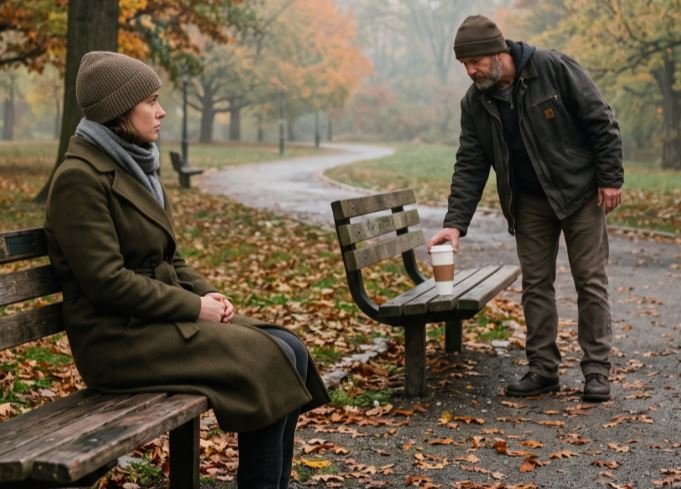
Sarah Miller first noticed the man because he did something that made absolutely no sense.
Every morning at almost exactly 7:40, he walked through the same city park carrying a single takeaway coffee. He never stopped to talk to anyone and never looked at his phone. He simply walked to an old wooden bench near the pond, placed the coffee carefully on the right side of the seat, and walked away.
The first time Sarah saw him, she assumed he had forgotten something.
The second time, she thought perhaps someone was meeting him there.
By the end of the first week, she realized it was a routine.
The coffee was always the same. Black coffee with one small packet of sugar placed underneath the lid. The man never drank it. He never waited for anyone. Within less than a minute, he would disappear through the eastern entrance of the park.
Sarah found the whole thing strange but harmless.
Then she noticed something else.
Nobody ever came for the coffee.
Sometimes a homeless man would pick it up. Sometimes a maintenance worker would throw it away. On one rainy morning, the cup remained on the bench for several hours before someone finally removed it.
Yet the next morning, another coffee appeared.
Same bench.
Same time.
Same man.
Sarah eventually became curious enough to change her morning routine. Instead of walking past the bench on her way to work, she sat several yards away and waited.
At 7:38, the man entered the park.
He was probably in his late forties, with short dark hair and a neatly trimmed beard. He wore the same dark jacket Sarah had seen every morning.
At 7:41, he reached the bench.
He placed the coffee down.
But this time, he didn’t immediately leave.
He stood there for several seconds staring at the empty seat.
There was something almost emotional about the way he looked at it.
Then he reached into his pocket, touched something inside, and walked away.
Sarah waited until he disappeared.
Then she approached the bench.
The coffee was still warm.
She picked it up.
Something was underneath it.
A small photograph.
Sarah unfolded it.
Her expression changed immediately.
The photograph showed a young woman sitting on the same bench.
The photograph looked old.
Maybe fifteen years old.
Sarah looked at the woman again.
She felt a strange chill.
The woman in the photograph looked remarkably similar to her.
Same dark hair.
Same narrow face.
Even the small scar near her eyebrow looked familiar.
Sarah turned the photograph over.
There was a handwritten date.
October 17, 2010.
And underneath it were four words:
“She always liked coffee.”
Sarah looked toward the path.
The man was gone.
She took the photograph home.
That evening, she searched the internet for the park and the date written on the photograph.
She found an old local newspaper article.
A young woman named Emily Carter had disappeared on October 17, 2010.
The last confirmed place she had been seen was this exact park.
Sarah stared at the article.
The photograph was of Emily.
The resemblance was undeniable.
But Sarah couldn’t understand why a stranger had been leaving coffee for someone who had disappeared fourteen years earlier.
The following morning, Sarah returned to the park.
The man was already there.
He placed another coffee on the bench.
This time, Sarah approached him.
“Excuse me.”
The man froze.
He slowly turned around.
Sarah asked him why he kept leaving the coffee.
He looked at her for several seconds.
Then he asked a question that made her uncomfortable.
“Who gave you the photograph?”
Sarah told him she had found it underneath the coffee.
The man’s face went pale.
He looked at the bench.
Then back at Sarah.
“I never put photographs there.”
Sarah showed him the picture.
The man took one look at it and stepped backward.
“That isn’t Emily.”
Sarah was confused.
She pointed at the woman.
“The newspaper says this is Emily Carter.”
The man shook his head.
“No.”
Then he looked directly at Sarah.
“That photograph was taken two days before she disappeared.”
Sarah felt a chill.
The man explained that Emily had been his younger sister.
For fourteen years, he had returned to the park every morning because this was the last place where anyone had confirmed seeing her.
The coffee wasn’t really for her.
It was a habit.
Emily had always ordered the same coffee.
He had started leaving one on the bench because he couldn’t bring himself to stop.
Sarah asked him why he had never told police about the photograph.
He looked confused.
“I’ve never seen that photograph before.”
Sarah showed him the back.
The handwriting wasn’t his.
The date wasn’t written in Emily’s handwriting either.
Then the man noticed something else.
There was a tiny number written beneath the date.
7:40.
The exact time he arrived every morning.
Police were contacted.
The photograph was examined.
Investigators discovered that it had been printed recently, even though the image itself was fourteen years old.
Someone had taken the original photograph, scanned it, and printed a new copy.
That meant somebody had access to the old photograph.
And somebody had deliberately placed it beneath the coffee.
Police reviewed the park’s security footage from the previous morning.
The man arrived at 7:39.
He placed the coffee down.
He walked away.
Nobody approached the bench for several minutes.
Then a woman appeared.
She walked directly toward the coffee.
It was Sarah.
But Sarah had never remembered approaching the bench that morning.
She watched the footage again.
At first, she assumed the camera time was wrong.
Then she saw herself clearly.
She walked toward the bench.
She stood there for several seconds.
And then she left.
Police asked Sarah what she had been doing at 7:40 that morning.
She said she had been sitting on the opposite side of the park.
The footage proved otherwise.
There was no explanation.
The investigators checked additional cameras.
One camera showed Sarah entering the park at 7:31.
Another showed her walking toward the bench at 7:40.
But none showed her leaving the area.
She simply disappeared from the camera network.
The next camera picked her up again nearly twenty minutes later at the park’s eastern entrance.
Sarah insisted she had no memory of the missing twenty minutes.
Investigators searched the area around the bench.
They discovered an old drainage access hidden beneath some vegetation.
Inside was a small metal box.
The box contained several objects belonging to Emily Carter.
A bracelet.
A library card.
A photograph.
And an old handwritten note.
The note was dated October 17, 2010.
It contained only one sentence:
“If I disappear, don’t believe the first person who says they saw me.”
The police reopened Emily’s case.
The investigation eventually revealed that Emily had been meeting someone in the park shortly before she disappeared.
That person had never been identified.
But there was another discovery.
The photograph Sarah had found wasn’t actually taken on October 15.
The date on the back had been altered.
The original photograph was taken on October 17.
The day Emily disappeared.
And the woman sitting on the bench wasn’t Emily.
It was someone else.
Someone who looked almost exactly like her.
Sarah.
Except Sarah had been only a child in 2010.
The investigation eventually uncovered a family connection nobody had expected.
Sarah’s mother had known Emily.
They had worked together years earlier.
And Sarah’s mother had deliberately hidden that relationship from her daughter.
When investigators confronted her, she finally admitted that Emily had contacted her shortly before disappearing.
Emily believed someone was following her.
She had asked Sarah’s mother to keep something safe.
But before she could explain what it was, Emily vanished.
Sarah’s mother had kept silent for fourteen years.
Until the photograph appeared.
Police never discovered who placed it under the coffee.
They never found Emily.
And they never determined how Sarah had appeared on the park’s security footage in a place she had no memory of visiting.
But several months later, Sarah returned to the park alone.
She sat on the same bench.
For the first time, she understood why the man had continued leaving coffee there.
It wasn’t really about waiting for Emily to return.
It was about refusing to let the world completely forget that she had existed.
Sarah stayed there for several minutes.
Then she noticed something beneath the bench.
Another coffee cup.
Fresh.
Still warm.
Sarah hadn’t seen anyone place it there.
She slowly lifted the cup.
Underneath was another photograph.
This one had been taken that morning.
It showed Sarah sitting on the bench.
On the back, someone had written:
“Now you know why she disappeared.”
And beneath those words was a second sentence.
“Don’t come back tomorrow.”