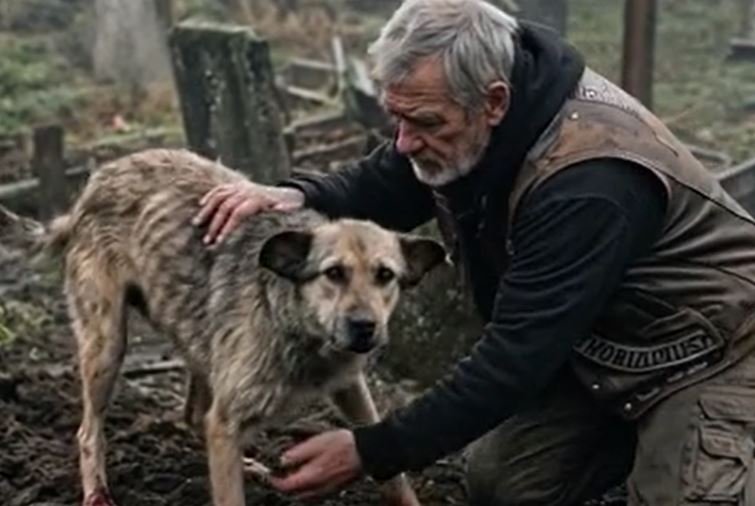
Offering didn’t behave like a dog.
She didn’t play fetch. She didn’t chase squirrels. She didn’t bark at mailmen or beg for scraps or do any of the things that dogs were supposed to do to prove they were dogs.
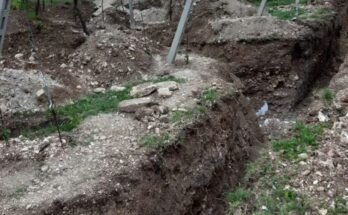
She dug.
Every morning at 5 AM, she woke Grave. Not with whining. With presence. She stood beside his bed, nose to the air, body vibrating with a frequency that he felt before he heard. She led him to the door. To his bike. To the road that wound through Mercer County’s forgotten places.
The first time, he didn’t understand.
She led him to the railroad tracks. Under the Route 9 overpass. To a drainage ditch that smelled of rust and stagnant water and something else — something that Offering’s nose had found and Grave’s eyes had not.
A body.
Not fresh. Three days, maybe four. A woman. Forty, maybe fifty. No ID. No shoes. The particular stillness of someone who had stopped being a person and started being a problem for whoever found her.
Grave called it in. The sheriff knew him. Knew the Revenant MC. Knew that when Grave called, it wasn’t a joke. The coroner came. The body went to the morgue. The case went to the folder marked “Unsolved, Unclaimed, Unnamed.”
Offering sat beside Grave as they watched. She didn’t wag. She didn’t whine. She just sat, her nose still working the air, her body still vibrating with the thing she had found and given and could not explain.
The second time was a week later.
The abandoned textile mill. Five miles outside town. Offering led Grave through broken windows, past rusted looms, to a basement where the air didn’t move and the darkness had weight.
A man. Young. Twenty, maybe. Overdose, the coroner said later. But Grave saw the bruises. Saw the way his hands were bound. Saw the story that Offering had smelled and he could only guess.
The third time was a child.
That was the one that broke Grave.
Offering led him to the river. The slow bend where teenagers swam in summer and no one went in winter. She stood at the bank, nose to the water, body rigid, and she made a sound — not a bark, not a whine, something between a howl and a prayer.
The child was in the reeds. Six years old, maybe seven. Dressed for school. Backpack still on. The particular tragedy of someone who had been going somewhere and never arrived.
Grave sat on the bank. He didn’t call it in. Not yet. He just sat, Offering beside him, and he wept. For the first time since 2003. For the first time since he had started burying strangers and pretending it didn’t cost him pieces of himself.
Offering pressed against him. Not for comfort. To give it. Her body warm, her nose wet, her presence the only thing that made the river bearable.
They found the mother three days later. Offering led them to her — a apartment, third floor, window open, pills on the nightstand. A note that didn’t explain, only apologized. A photo on the dresser. The child. The river. The story that Offering had smelled before anyone knew to look.
The Revenant MC changed after that.
Not their name. Not their patches. Not their bikes or their funeral home or their cemetery. But their purpose.
They became searchers.
Not officially. Not legally. Just twelve bikers and one dog who rode Mercer County’s back roads at dawn, looking for what the world had thrown away. Offering led. They followed. They found the lost, the dead, the forgotten. They gave them names when they could. They buried them when they couldn’t. They became the thing that Grave had always believed in — the witness at the end, the hand that closes the eyes, the voice that says you existed, you mattered, you were seen.
Offering worked for six years.
She found 47 bodies. She led them to 12 living — the ones who weren’t dead yet, only dying, the ones who needed an ambulance instead of a hearse. She became known in Mercer County. The Revenant Dog. The Grave Hound. The offering that kept giving.
She died at 11.
Not from work. From age. From a heart that had beaten too hard for too long, that had smelled too much death and still wagged at dawn.
Grave buried her in Section 7.
Not in a pauper’s plot. In the center. The place where they buried their own. He carved her marker himself — not cardboard, stone, the kind that lasted. It read:
OFFERING — She Dug for the Dead. She Found the Living. She Gave What No One Asked For.
He still rides at dawn.
Every morning. Same route. Same roads. Same sidecar, now empty, now filled with flowers that he places on her grave and the graves of the ones she found.
The Revenant MC still searches. New dog now. A bloodhound, failed police candidate, too gentle for narcotics work. Named Receiver. Because that’s what they do now — they receive what Offering started. They continue the gift.
But Grave knows.
He knows that no dog will be Offering. That no nose will find what she found. That no creature will ever again lead him to a river at dawn and teach him that grief is not the opposite of love, but its continuation.
He visits her marker every day. He places a flower. He sits in the grass that grows over Section 7, among the unmarked and the named and the ones who were both, and he feels the vibration of the earth — the same vibration he felt as a gravedigger, as a con, as a man who learned that the only way to live with death is to serve it with dignity.
Offering taught him that.
Not with words. With digging. With presence. With the particular grace of a creature who spent her life looking for what others couldn’t bear to find, and who gave it anyway — to Grave, to the Revenant MC, to Mercer County’s forgotten dead.
She was not a rescue.
She was not a pet.
She was an offering.
And she gave until there was nothing left to give, and then she gave her absence — the empty sidecar, the dawn rides, the flowers on stone — so that Grave would remember what it meant to be needed by something that asked for nothing.
He remembers.
Every morning. Every flower. Every vibration of the earth beneath his boots.
He remembers.