Huck didn’t understand the orchard at first.
He was afraid of the tractors — the vibration through the ground, the particular tremor that he felt in his paws but couldn’t identify. He was afraid of the wind in the trees — the movement he saw but the silence he didn’t hear, the particular disorientation of a deaf dog watching a world that made no sound.
Sam adapted.
He didn’t use voice commands. He used touch — a hand on the shoulder meant stay. A stroke down the back meant come. The particular language of patience, developed over months, that replaced words with presence.
Huck learned the orchard by vibration.
The particular sensitivity of a deaf dog — his paws became his ears. He felt the irrigation water moving through underground pipes. He felt the wind loading the branches, the particular stress of wood that was bending too far. He felt Sam’s footsteps from 100 yards away, the particular rhythm of a man who walked with arthritis, who favored his left leg, who stopped every 20 minutes to rest his hands.
Sam noticed.
Not immediately. But eventually. He noticed that Huck would stop at certain trees and press his nose to the bark, his paws shifting as if reading Braille. He noticed that Huck would leave the house 10 minutes before the mail truck arrived — feeling its engine through the earth, the particular vibration that traveled faster than sound.
He noticed that Huck slept differently.
Not deeply. With his paws touching the floor, even on his bed, as if he needed constant contact with the ground to feel safe. The particular vigilance of a creature who cannot hear danger coming and so must feel it.
October arrived.
The harvest. The particular madness of 40 acres of apples that needed picking in three weeks before the first frost. Sam hired two high school kids. He worked 12-hour days. His hands swelled. His back ached. He was pruning an old Gravenstein tree — 80 years old, heavy with fruit, the particular matriarch of the orchard — when Huck found him.
Huck was running.
Not playing. Running with the particular urgency that Sam had never seen in him — ears flat, body low, paws barely touching the ground. He hit Sam at full speed — 55 pounds of muscle against 180 pounds of farmer.
Sam fell.
Not gracefully. He crashed into the grass, his pruning shears flying, his hip hitting a root. He was angry — the particular anger of a man who is tired and in pain and doesn’t understand why his dog has attacked him.
Then the tree fell.
Not gradually. It cracked — a sound Sam heard from the ground, a sound that Huck felt through his paws 30 seconds before it happened. The roots, rotted by decades of irrigation, gave way. The 80-year-old Gravenstein leaned, groaned, and crashed onto the exact spot where Sam had been standing.
His ladder was crushed.
His pruning basket — metal, heavy — was flattened. The branch he had been reaching for was buried in dirt. The particular violence of gravity and wood, rendered silent except for the crash, would have killed him.
Huck stood over him.
Not wagging. Not barking. Just standing, his paws on Sam’s chest, his nose to Sam’s face, checking. The particular assessment of a dog who has just done something he cannot explain, who has acted on information that humans don’t have access to.
Sam understood.
Not immediately. But as he lay in the dirt, looking at the tree that had almost killed him, feeling Huck’s paws on his chest, he understood. Huck hadn’t attacked him. Huck had felt the roots cracking through the earth. He had felt the tree’s weight shifting. He had run, not to hurt, but to move Sam out of the way.
The only way to warn a deaf human was to touch him.
And Huck had touched him with everything he had.
Part 3: The Seismic
Sam told no one.
Not because he was embarrassed. Because he didn’t think anyone would believe him. My deaf dog felt a tree falling through his paws. The particular statement of a man who knows he sounds crazy.
But he started watching Huck.
He placed him in the orchard during pruning. Not working — just present. Huck would wander, nose to the ground, paws shifting. When he stopped at a tree and wouldn’t leave, Sam moved his ladder. Every time, within an hour, something would happen — a branch would crack, a root would settle, the particular movement of old wood that farmers call “orchard breathing.”
Huck was a seismic sensor.
Not scientifically. Not reliably. But with the particular accuracy of a creature who had learned to read the earth because he couldn’t hear the sky. Sam trusted him. He stopped pruning when Huck said no. He moved his equipment when Huck blocked his path. He let a deaf dog become his safety officer.
The video happened by accident.
One of the high school kids — Jake, 17, TikTok on his phone — filmed Huck stopping Sam from climbing a ladder. He posted it with the caption: “My boss’s dog is literally an earthquake detector.”
The video hit 30 million views.
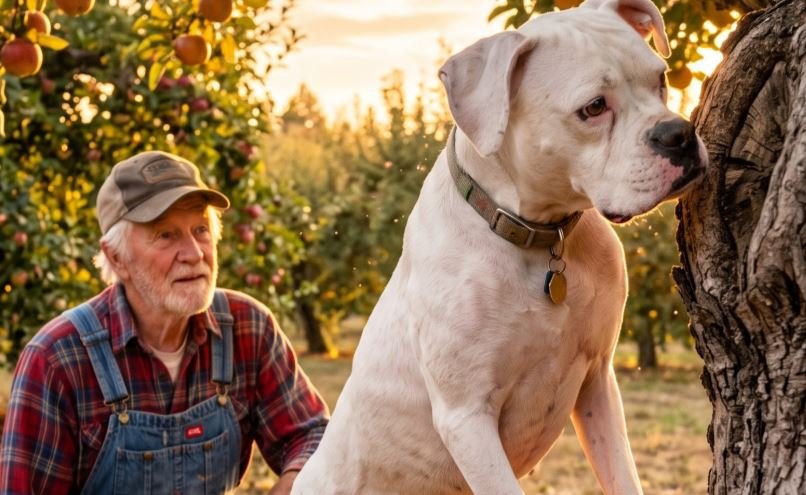
Not because of Jake. Because of Huck — the particular image of a white Boxer mix placing his paws on a rung and refusing to move, while an old farmer sighed and climbed down. The particular comedy of a dog who had become the boss.
The comments were a flood.
“Deaf dogs use vibration to map the world. This is real science.”
“The dog is literally reading the tree’s heartbeat through the roots.”
“Someone give this dog a hard hat.”
“Old man: ‘I’m the farmer.’ Dog: ‘Not today, human.'”
Sam didn’t understand TikTok.
But he understood that his phone was ringing — reporters, orchard supply companies, a documentary crew from Seattle. The particular attention that the internet gives to stories that confirm what people want to believe: that animals are smarter than we think, that old farmers and broken dogs can save each other, that there is magic in the world if you know where to look.
The orchard was saved.
Not by the harvest — though that was good. By the visitors. People drove from Seattle, from Portland, from California to see Huck. To watch him work. To feel his paws — Jake started a thing, “Huck’s Paw Reading,” where visitors could place their hands on the ground while Huck stood nearby, feeling the earth together.
Sam started selling “Seismic Honey.”
Not from the orchard — from a neighbor’s hives. With labels showing Huck’s face. The particular capitalism of a farmer who has found a way to survive without selling his land.
Huck wore a bandana.
Red. With a white cross, like a medic. The particular uniform of a dog who had found his job — not herding, not guarding, not retrieving. Just feeling. Just being present. Just keeping his human safe by knowing things that humans couldn’t know.
He worked for 6 more years.
Not every day. Sam retired from pruning the old trees — too dangerous, even with Huck. They planted new stock, dwarf varieties, the particular future of an orchard that would outlive them both.
Huck died at 14.
Not from a falling tree. From age. From the particular decline of a body that had spent a lifetime reading vibrations and was finally too tired to feel the earth move.
Sam buried him beneath the Gravenstein.
The one that fell. The one that had almost killed him. The particular spot where Huck had knocked him down and changed everything.
He didn’t use a stone.
He planted a new tree — a Gravenstein sapling, grafted from the old wood. The particular continuity of orchards, where death becomes rootstock and loss becomes growth.
The marker was simple. Sam carved it with hands that still ached, that still gripped pruning shears on good days, that had learned to trust a dog’s paws more than their own grip:
HUCK — He Couldn’t Hear the World. But He Felt It Move. And He Moved Me.
People still visit.
They place their hands on the ground. They feel the roots. They watch the sapling grow. And they remember — if they know the story — that some dogs don’t need ears to listen.
They just need paws.
And someone who is willing to be knocked down.