Part 2: The 90 Seconds
Marcus didn’t think. He just trusted.
He grabbed his radio with his bleeding hand. “All units. Full evacuation. West wing. I repeat, full evacuation. This is not a drill.”
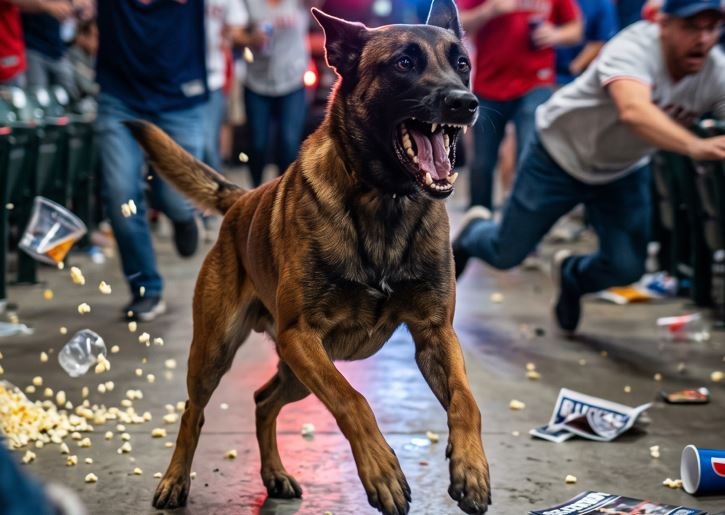
The captain argued. Marcus didn’t listen. He looked at Atlas, still barking, still creating chaos, and he understood. The dog wasn’t broken. He was improvising.
The stadium alarm blared. 80,000 people became a river of confusion. Marcus grabbed Atlas and ran back toward the storage room — not to defuse, but to confirm. To give the bomb squad the data they needed.
They found the device behind the folding chairs. A propane tank. A cell phone. And a secondary trigger — a pressure plate wired to the door. If Marcus had opened that door when Atlas first stopped, the signal would have gone out. The stadium would have become a grave.
The timer showed 94 seconds when they found it. Not enough time to defuse. Not enough time to clear the whole building. But enough time for the west wing to empty.
They ran.
Marcus and Atlas were 200 yards away when the storage room blew. The concussion knocked them both flat. The fireball ate the corridor. The west wing collapsed inward, but the stands were empty. The concourse was clear. The only injuries were from the stampede — minor. Treatable. Forgettable.
Atlas lay on his side, breathing hard, his ears ringing. Marcus crawled to him. He expected the dog to be shaking. To be traumatized. To be the broken thing everyone assumed he was.
Instead, Atlas stood up. He shook the dust from his coat. He walked to Marcus, sat down, and placed his bleeding paw in his handler’s hand.
He sat.
The alert he had refused to give. The signal he had withheld to save them both. He was giving it now, in the ashes, when it was finally safe.
Marcus cried. He didn’t care who saw.
The review board called it a “training anomaly.” They said Atlas had “reacted to handler stress.” They refused to put it in the manual — a dog that doesn’t alert, a dog that causes chaos, a dog that breaks protocol to save lives. You can’t train that. You can’t replicate it.
But Marcus knew the truth.
Atlas didn’t break. He evolved. In the space between a sniff and a sit, he had weighed six years of training against 80,000 lives, and he had chosen to become something the manual had no name for.
A liar. A hero. A dog who understood that sometimes the only way to tell the truth is to break every rule.
They retired him six months later. Not because he was old. Because Marcus refused to work with any other dog. They moved to a cabin in the mountains. No bombs. No crowds. Just a porch, a fireplace, and a Belgian Malinois who still sat — perfectly, obediently, beautifully — every time Marcus came home.
On the wall above the fireplace, Marcus hung Atlas’s final badge. The one they almost took away. And beneath it, a plaque he had made himself:
“Atlas. K9 Unit 9. He did not sit for death. He stood for life.”