At 1:44 a.m., Chloe received a notification that her phone had finished organizing her photos.
“New Memories Found: A Weekend with Mom.”
Chloe froze. Her mother had passed away four years ago. She hadn’t taken a new photo of her mother since the funeral, and she had already backed up all the old ones to a secure hard drive.
Curious and slightly shaken, she opened the “People” album.
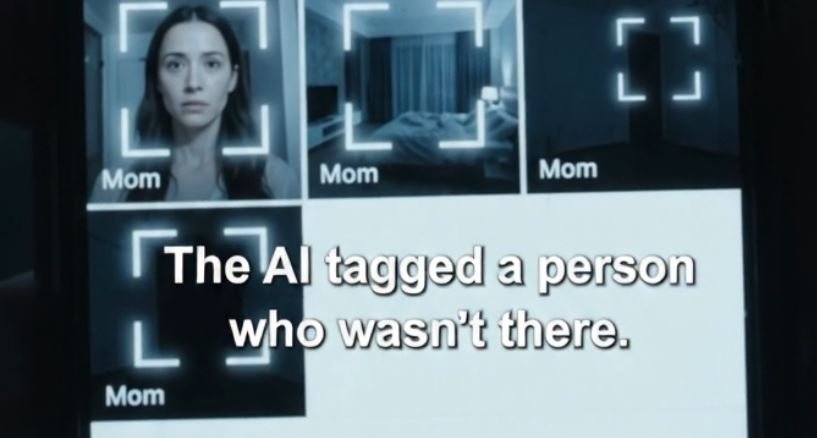
The AI had created a new folder labeled with her mother’s name. But when Chloe clicked on it, the thumbnails were not of her mother.
They were photos of Chloe’s empty apartment.
There was a photo of the kitchen counter at night. A photo of the dark hallway leading to the bathroom. A photo of the corner of her bedroom.
In every single image, the AI had drawn a small square over a patch of empty air and labeled it: “Mom.”
Chloe felt a cold shiver run down her spine. She lived alone in a high-rise apartment in Chicago. The doors were always double-locked, and the building had 24-hour security. She assumed the software was glitching, perhaps confusing a shadow or a curtain for a human face.
She tried to delete the folder, but the app wouldn’t allow it.
“Error: System process in progress. Cannot delete active memories.”
Chloe put the phone face down on the nightstand and tried to go back to sleep. But ten minutes later, the phone chimed again.
“New Photo Added to ‘Mom’.”
She picked up the phone. The new photo had been taken just seconds ago.
It was a picture of Chloe, sleeping.
The angle was from inside her own bedroom closet. The door of the closet was slightly ajar, and the camera had captured Chloe’s sleeping form through the narrow gap.
And in the dark space right next to the camera lens, the AI had drawn another square.
“Mom.”
Chloe scrambled out of bed and threw open the closet door. It was empty. Only her coats and shoes were there, hanging silently in the dark.
She checked the photo’s metadata. The camera used was the front-facing lens of her own phone.
But her phone had been on the nightstand, three feet away from the closet.
She grabbed her keys and ran to the living room, her heart pounding. She needed to leave, to go to a hotel, to get away from the apartment. But as she reached for the front door, her phone vibrated again.
This time, it wasn’t a notification. It was a FaceTime call.
The caller ID showed her own number.
Chloe didn’t answer. She watched the screen until the call ended, then she opened her “Recently Deleted” folder.
There were twelve new photos in the folder.
Each one was a selfie of Chloe, but she wasn’t the one holding the phone. In every photo, she looked terrified, her eyes wide, her mouth open as if she were screaming.
And in the reflection of her pupils, she could see a woman standing behind her.
The woman was wearing the same dress Chloe’s mother had been buried in.
Chloe dropped the phone. The screen cracked, but the display remained active. A new notification appeared, glowing through the spiderweb of broken glass.
“FaceID Recognized: Welcome Home, Mom.”
The front door unlocked by itself.
The heavy deadbolt turned slowly, the sound echoing in the silent apartment. The door didn’t open, but the handle began to jiggle, as if someone were trying to find the right way to turn it.
Chloe ran to the balcony. She was on the 22nd floor; there was nowhere to go.
She looked at her phone on the floor. The screen was now showing a live feed from the camera.
The view was from the ceiling, looking down at Chloe on the balcony.
She looked up, but there was no camera on the ceiling. There was only the white plaster and the smoke detector.
On the phone screen, the woman in the burial dress was now standing on the balcony with Chloe. She was leaning over the railing, pointing down at the street below.
The woman turned toward the “camera” and spoke.
The sound didn’t come from the phone. It came from the air all around Chloe.
“You forgot to say goodbye, Chloe.”
Chloe felt a hand—cold and dry like old paper—touch the back of her neck.
She turned around, but the balcony was empty.
She looked back at the phone.
The screen showed the woman pushing Chloe over the railing.
Chloe felt a sudden, violent shove.
She grabbed the metal bar, her feet slipping on the wet concrete. She looked down at the street, hundreds of feet below.
Her phone began to play a slideshow.
The music was a slow, distorted version of her mother’s favorite song.
The photos showed Chloe’s life, but in reverse. Chloe as a graduate. Chloe as a teenager. Chloe as a child.
In every photo, the woman in the burial dress was standing in the background, getting closer with every frame.
The final photo was of a newborn baby in a hospital crib.
The AI square was over the baby’s face.
“Tag: Chloe.”
Then the tag changed.
“Tag: Mom.”
Chloe felt her grip failing. Her fingers were numb, and the cold wind was pulling at her clothes.
She looked at the phone screen one last time.
The woman in the dress was now holding the phone. She was looking into the camera and smiling.
“It’s my turn to be the daughter,” the woman whispered.
Chloe fell.
The wind rushed past her ears, the city lights blurred into long streaks of white and yellow. She closed her eyes and waited for the impact.
But she didn’t hit the ground.
She woke up in a hospital crib.
The air smelled of antiseptic and fresh flowers. She tried to move, but her limbs were small and weak. She tried to speak, but only a high-pitched cry came out.
A woman leaned over the crib.
The woman looked exactly like Chloe.
She was wearing Chloe’s favorite gray sweater and holding a smartphone.
The woman smiled and took a photo of the baby.
Chloe heard the shutter sound of the camera.
Then the woman looked at her phone and whispered, “Look, Mom. The AI just tagged you.”
She showed the screen to the baby.
The AI had drawn a square over the baby’s face.
“Tag: Mom.”
The woman tucked the phone into her pocket and walked out of the room.
Chloe—the baby—looked at the ceiling.
A small notification light was glowing on the smoke detector.
And in the reflection of the glass window, she saw a young woman standing in the corner of the room, wearing a burial dress, waiting for the clock to strike 1:44.