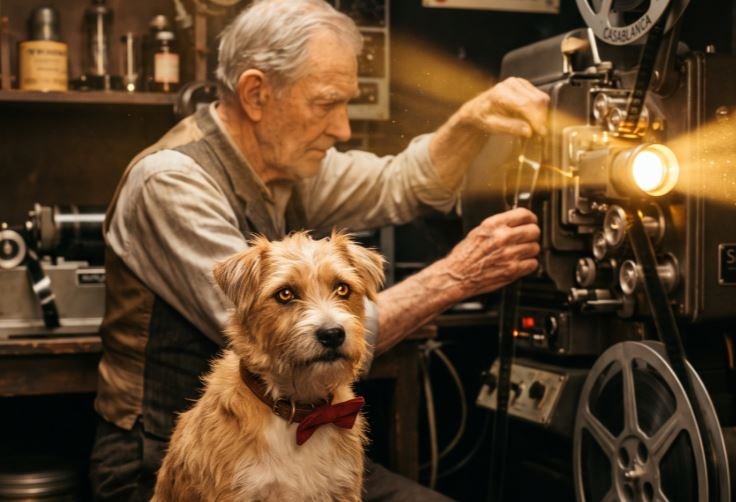
Henry’s eyes got worse.
Not gradually. In steps. The particular cruelty of macular degeneration — you wake up and the center of the crossword is gone. You thread a film and can’t tell if the image is in frame.
He was practicing the changeover.
The Majestic still ran 35mm. Two projectors. Reel 1 on Machine A, Reel 2 on Machine B. At the cue — a small circle of light in the upper right corner of the film — you started Machine B. At the second cue, you switched the shutter. The audience never knew.
Henry couldn’t see the cues.
He tried a loupe. He tried bright lights. He tried the particular desperation of a man who has defined himself by one skill and is watching it disappear. Nothing worked. The dots were too small. His center vision was too gone.
He sat in the booth, unreeling film that he couldn’t thread properly, and he cried.
Not loudly. Just tears on polyester. The particular grief of a man who has lost his wife, his theater, and now the only thing he was good at.
Reel came to him.
Not because he was called. Because Henry made a sound — a particular frequency of despair that dogs recognize better than humans. Reel pressed against his leg. He licked Henry’s hand. Once.
Henry didn’t notice.
Not at first. But Reel kept doing it. Every time Henry sat at the projector, trying to see the cues, Reel would jump onto the stool beside him. He would watch the wall where the projector’s beam created a small, bright rectangle — the image, reversed and tiny, that told the projectionist what was on screen.
Henry noticed something strange.
When the film was threaded correctly — in frame, in focus — Reel sat still. Tail down. Watching.
When the film was threaded wrong — when the image was cropped, or out of focus, or the gate wasn’t closed properly — Reel whined.
Not loudly. A small sound. But consistent. Every time the image was soft, Reel shifted. Every time the frame line was visible — the particular error that meant the film was riding high or low — Reel stood. He would paw at Henry’s arm.
Henry tested it.
He deliberately threaded a reel wrong. Cropped the top of the image. Reel stood immediately, whined, pawed.
Henry fixed it. Reel sat. Quiet.
He tried another error. Out of focus. Reel made the same sound.
Henry realized — not immediately, but with the particular slowness of a man who doesn’t want to believe in miracles — that Reel was reading the light.
Not understanding film. Not comprehending The Wizard of Oz. Just… seeing. Seeing what Henry couldn’t. The particular clarity of a dog’s vision, still intact, watching the beam and knowing — somehow, impossibly — when the image was right and when it was wrong.
It wasn’t magic.
It was pattern. Reel had watched Henry thread film for weeks. He had learned the particular geometry of the projected rectangle — the way it should look when perfect. When that geometry changed, he responded. Not because he understood cinema. Because he understood Henry. Because he had decided that this man’s work was his work, and he would not let it fail.
Henry taught him the cues.
Not deliberately. Just… included him. He placed Reel on the stool beside the projector. He ran Reel 1. He pointed to the beam. He waited.
The first cue appeared — a small flash in the corner of the projected image. Reel barked.
Once. Sharp.
Henry started Machine B.
The second cue appeared. Reel barked again.
Henry switched the shutter.
The changeover was seamless. The audience below — all 12 of them, the particular crowd of a dying theater on a Tuesday — never knew that a 67-year-old blind man and a stray terrier had just performed the work of a $50,000 digital automation system.
They did it again. And again. For three weeks, every night, every screening.
Reel never missed a cue.
Part 3: The Final Night
December 15th.
The Majestic’s final screening. The Wizard of Oz. 35mm print, faded but beautiful, the particular colors of a film that had been loved for 80 years. The theater was full — not because of the movie, but because of Henry. Because Ashland had heard that the old projectionist was going blind, that the theater was dying, that this was the end of something.
Henry was terrified.
Not of blindness. Of failure. Of threading the final reel wrong, of burning the final print, of proving that he was too old, too broken, too finished to do the one thing that had given his life meaning.
Reel was calm.
He sat on his stool, washed, brushed, wearing a small red bow tie that Henry had bought at the dollar store. The particular absurdity of a stray terrier in a bow tie, ready for his premiere.
Henry threaded Reel 1.
He couldn’t see the gate. He couldn’t see the sprockets. He did it by touch — 43 years of touch — while Reel watched the beam, whined once when the frame was off, went silent when Henry corrected it.
The film started.
The overture played. The curtains parted — manually, because the automation had broken in 1987 and Henry had never fixed it. The audience settled into the particular darkness of a movie theater, that sacred space where the world disappears.
Henry and Reel ran the show.
Reel 1 to Reel 2. Reel 2 to Reel 3. Every cue, every changeover, every particular moment when the film needed tending. Reel barked softly at the cues — not loud enough to disturb, just loud enough for Henry, who had learned to listen for that sound the way he once listened for the projector’s hum.
At Reel 5, something happened.
The film jammed. Not Henry’s fault — an old splice, a weak bond, the particular fragility of a print that had been run too many times. The projector stopped. The screen went white. The audience murmured.
Henry couldn’t see the jam.
He knew where it was — by sound, by memory, by the particular knowledge of a machine he had lived with for decades. But he couldn’t see to fix it. Not in the dark. Not with his eyes.
Reel jumped off the stool.
He ran to the projector. Not afraid of the machine — he had spent months in its presence, had learned its heat and its smell and its particular language. He stood on his hind legs, paws on the projector body, and he looked at Henry.
Then he looked at the film path.
Henry followed his gaze.
Not literally — he couldn’t see. But he followed the direction of Reel’s attention, the particular angle of a dog’s nose pointing to the exact spot where the film had buckled. Henry reached. His fingers found the loop. He loosened the tension. He rethreaded.
Reel barked once.
Good.
Henry started the projector.
The image returned. Dorothy was in the witch’s castle. The audience — unaware of what had happened in the booth — cheered. They thought it was a dramatic pause.
Henry sat down.
His hands were shaking. Reel climbed back onto the stool. He pressed against Henry’s side. The particular warmth of a creature who had just saved something impossible.
The film finished.
The lights came up. The audience applauded — not for the movie, but for the moment, for the ending, for the particular grief of saying goodbye to a place that had held their first dates, their childhood Saturdays, their particular memories of who they were.
A girl in the audience filmed the booth.
Not the screen. The booth. She saw, through the small square window, the silhouette of an old man and a small dog. She saw Reel bark at the final cue. She saw Henry’s hand on the dog’s head.
She posted it.
Not for viral fame. Just because it was beautiful. Because the particular image of a man and a dog running a movie theater touched something in her that she didn’t have words for.
The video hit 40 million views in 72 hours.
The algorithm — that mysterious, merciless god — found its offering. A blind projectionist. A stray dog. A dying theater. The particular story that the internet loves — underdog, literally, saving art, saving history, saving the particular magic of movies.
The comments were a flood.
“I’m a projectionist. This is what we do. This is what we love.”
“The dog barking at the cue mark. I can’t stop crying.”
“Someone save this theater.”
“This is why 35mm matters. This is why dogs matter.”
Someone started a fundraiser.
Not Henry. He didn’t know how. A film archivist in Chicago saw the video, created a GoFundMe, and aimed for $200,000 — enough for digital projection, enough for renovations, enough to save The Majestic.
It raised $1.2 million.
Because the story spread — to film blogs, to dog pages, to the particular corners of the internet where people still believe that old things are worth keeping. Because Henry and Reel had become symbols of something larger than themselves — the fight against obsolescence, the partnership between humans and animals, the particular stubbornness of love.
The Majestic didn’t close.
It became a nonprofit. A rep house. A 35mm preservation center. Henry didn’t own it — he never had — but he was hired as Director of Projection, a title he had never held, with a salary he had never earned.
He worked for 6 more years.
Not alone. With Reel. Every night, in the booth, running 35mm prints for audiences who came from Cleveland, from Columbus, from Chicago — people who wanted to see a man and a dog run a projector, who wanted to believe that the old ways still worked, that magic was still possible.
Reel died at 14.
In the booth. On his stool. During a matinee of Singin’ in the Rain. Henry found him when the film ended — still warm, still watching the beam, still ready for the next cue that would never come.
Henry didn’t show a film that night.
He sat in the booth. He held Reel. He told him — because you tell dogs things, even when they’re gone — that he had been the best projectionist he had ever worked with. That the light was always right when Reel was watching. That he had saved more than a theater. He had saved a man who was going blind and thought he had nothing left to see.
Henry had a plaque made.
Not for the lobby. For the booth. On the wall, beside the projector, where every projectionist who followed would see it:
REEL — He Couldn’t Thread Film. But He Could Read Light. And That Was Enough.
Henry retired the next year.
Not because he couldn’t work. Because working without Reel was threading film without seeing the beam — possible, but empty. He moved to a house near the theater. He visited every Friday. He sat in the back row, in the dark, and listened to the projector hum.
And sometimes — when the changeover was seamless, when the image was perfect, when the particular magic of cinema worked exactly as it should — he heard a bark.
Not real. Memory. The particular echo of a dog who had learned to read light, who had saved a theater, who had proven that you don’t need eyes to see what matters.
You just need someone who watches the beam for you.