Route 66 outside Kingman, Arizona, doesn’t look like a place where memories live. It looks like a place where memories go to die. Cracked asphalt. Rusted signs. Empty diners with boarded windows. The desert reclaims everything eventually.
But for 47 days, a dog sat in the middle of the road.
He wasn’t a puppy. Maybe eight years old. A German shepherd mix, scarred muzzle, one ear that didn’t stand quite right, ribs showing but not starving. He had a collar — weathered leather, cracked at the edges, with a small iron cross tag that had been polished smooth by time and wind.
Truckers saw him first. They honked. He moved to the shoulder. Waited. When they passed, he walked back to the center line.
Motorcyclists saw him next. Every biker who rode that stretch — and in June, there were hundreds, Route 66 pilgrims heading west — saw the dog. Some stopped. Offered water. Offered food. He took the water. Ignored the food. Sniffed their jackets. Their gloves. Their helmets.
Then he walked back to the center line and sat down.
A local deputy tried to catch him. The dog evaded. Not aggressively. Just… purposefully. He would run fifty yards into the desert, wait for the deputy to give up, then return to the same spot. Mile marker 53. A straight stretch of road with nothing but mesas and sky.
The deputy posted on Facebook. “Dog on 66. Won’t leave. Won’t eat much. Just sits. Someone’s pet, maybe. If you know him, come get him before he gets hit.”
Nobody came.
Day 48
Caleb Dunn was not supposed to be on Route 66.
He was supposed to be in Flagstaff. A PTSD therapy appointment. His second one. The first had gone badly — too many questions, too few answers, too much sitting still. He had canceled the second twice. This time, he just didn’t show up. Got on his bike and rode west instead.
He saw the dog from half a mile away. A dark shape in the center of a road that shimmered with heat. He slowed. The dog didn’t move. Just sat there, ears perked, watching the approaching engine sound like it was the only thing in the world.
Caleb stopped twenty feet away. Killed the engine.
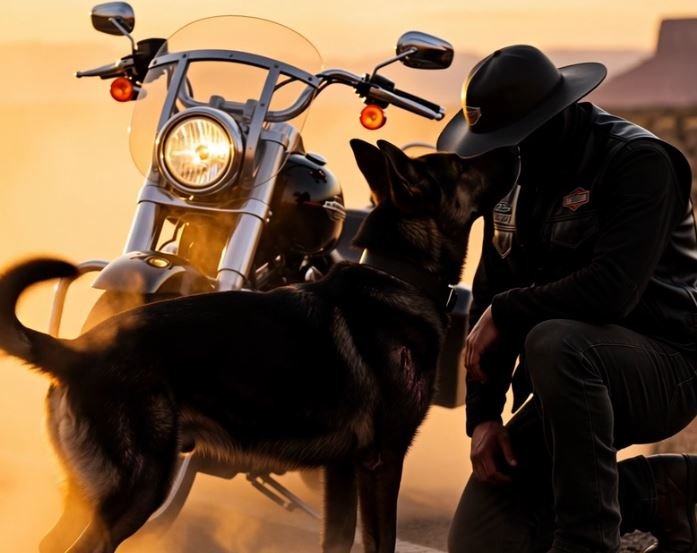
The dog stood. Slowly. Like an old man getting up from a chair. He limped slightly — left front paw, something wrong with the shoulder. He walked to Caleb’s bike. Not running. Not excited. Just… determined.
He reached Caleb’s leg. Lifted his nose. Pressed it into Caleb’s leather vest. Right where the Iron Mercy patch would be. And he inhaled.
Deeply. Fully. Like he was trying to pull a memory out of the leather.
Then he stopped.
His tail — which had been wagging in small, hopeful circles — went still. He pulled back. Looked at Caleb’s face. Really looked. And Caleb saw something break in the dog’s eyes. Not aggression. Not fear. Recognition that this was not the right person. Hope, dying.
The dog turned and walked back to the center line. Sat down. Faced the east. Waited for the next bike.
Caleb sat on his idling Harley for a long time. He didn’t know what to do. He had treats in his saddlebag. Water. A rope. He could call animal control. Could try to catch the dog. But something about the way the dog had sniffed his vest — specifically his vest, specifically the patch — made him stay.
He looked at the dog’s collar. The iron cross tag.
He knew that tag.
The Tag
Caleb pulled out his phone. Scrolled through his contacts. Found a number he hadn’t called in two years. A man named Red, Oklahoma chapter president of Iron Mercy Riders.
“Red,” Caleb said when the man answered. “It’s Caleb. Arizona chapter. I need to ask you something. Did you lose a brother recently? On Route 66?”
Red was quiet for a long time. Then: “Danny Holloway. Six weeks ago. Heart attack on his bike. Mile marker 53, outside Kingman. Died before the ambulance came. Why?”
“There’s a dog here,” Caleb said. “Sitting on the road. Won’t leave. Has an Iron Mercy tag on his collar.”
Red made a sound. Not a word. Something broken. “Ranger,” he said. “Danny’s dog. Eight years. Rode with him everywhere. Danny was doing a solo run to California. Ranger was in the sidecar. When Danny went down, the sidecar tipped. Ranger got out. Ran into the desert. By the time we got there, he was gone. We searched for days. Figured he was dead. Coyotes. Heat.”
“He’s not dead,” Caleb said. “He’s waiting.”
The Wait
Caleb rode back to the spot that evening. The sun was going down, turning the mesas purple and gold. Ranger was still there. Still sitting. Still facing east.
Caleb sat on the road beside him. Cross-legged. In his jeans and his Iron Mercy vest. He didn’t try to pet the dog. Didn’t offer food. He just sat there and told Ranger about Danny.
“Danny was a good man,” Caleb said. “I met him once. At a rally in Texas. He bought me a beer. Told me about you. Said you hated sidecars. Said you preferred the wind. Said you were the only passenger he ever trusted not to fall asleep and lean the wrong way.”
Ranger’s ear twitched.
“He didn’t suffer,” Caleb said. “The doctor said it was fast. His heart just… stopped. Like turning off a light. He was probably looking at the sunset when it happened. Probably thinking about you. Probably thinking he’d see you in California.”
Ranger lay down. His head on his paws. His eyes still on the road. But he was listening.
“He’s not coming back,” Caleb said. His voice cracked. “I know you know that. I know you’ve smelled enough bikers to know none of them are him. But you keep checking. Because what if? What if this one? What if this smell?”
Caleb reached out. Slowly. Let Ranger smell his hand. The dog didn’t pull away. Just sniffed. Then, slowly, he leaned into Caleb’s palm. One small movement. A surrender.
“I can’t bring him back,” Caleb said. “But I can take you home. To Oklahoma. To Red. To the chapter. To people who knew his voice. Who have his pictures. Who will tell you stories until you don’t need to wait anymore.”
Ranger looked at him. For a long time. Then he stood. Walked to Caleb’s bike. Stood beside the sidecar — the empty sidecar Caleb had been hauling for a friend — and looked up.
“Yeah,” Caleb said. “I know. You hate sidecars. But it’s just for the ride home. Then you can ride pillion. Like Danny did. Like you always wanted.”
Ranger climbed into the sidecar. Settled down. Looked at the road one last time. Then closed his eyes.
Oklahoma
They rode for three days. Caleb took it slow. Stopped every two hours. Let Ranger walk. Let him sniff. Let him choose when to move on.
In Oklahoma, Red met them at the chapter house. Six other riders. All in vests. All with Iron Mercy patches. When Caleb lifted Ranger from the sidecar, the dog walked to Red. Sniffed his vest. Red smelled different — older leather, pipe tobacco, a different soap. But underneath, the same road. The same wind. The same brotherhood.
Ranger’s tail wagged. Once. Twice. Then stopped. Not because he was disappointed. Because he was home.
Red knelt. Ranger went into his arms. The old biker — 67, white beard, hands that had held handlebars for forty years — cried openly. The other riders turned away. Some cried too. Caleb stood by his bike and watched and felt something in his chest loosen.
That night, the chapter sat on the porch. They told Ranger stories about Danny. The time Danny rode through a hailstorm because he didn’t want to leave Ranger at a motel. The time Danny built a custom sidecar with a padded bed because Ranger’s hips were getting old. The time Danny said, “If I go before he does, you make sure he knows. You make sure he doesn’t wait.”
They told stories until 2 AM. Ranger lay on Danny’s old blanket — the one from the sidecar, the one Red had kept — and listened. His eyes moved from speaker to speaker. His ears tracked every voice. He didn’t understand the words. But he understood the love underneath them.
The Road That Remembered
Caleb stayed for a week. He rode with the Oklahoma chapter. He sat with Ranger on the porch. He learned that Ranger didn’t sit in the road anymore. Didn’t run to passing bikes. He had smelled enough brothers. Heard enough stories. He knew, now, in the way dogs know things, that Danny was gone but not forgotten.
On his last day, Caleb rode out to a stretch of country road behind the chapter house. Ranger followed on his own four legs — his shoulder was better, his gait stronger. They sat together on the white line, watching the sunset.
Caleb thought about Danny. About the way he died — fast, alone, on a beautiful road, doing the thing he loved most. About Ranger, waiting for 47 days, checking every biker, hoping against hope.
He thought about his own ghosts. Afghanistan. The friends he had lost. The way he still checked his phone sometimes, expecting a text from a number that would never text again.
Ranger pressed against his leg. Warm. Present.
“You taught me something,” Caleb said. “The road remembers us. Every mile we ride. Every friend we make. Every dog we love. It holds it. All of it. And when we come back — even if we’re different, even if we’re broken — the road knows. It remembers.”
Ranger looked up at him. His amber eyes caught the last light. For a moment, Caleb saw Danny in them. Not literally. But in the way the dog looked at the world. With trust. With patience. With the understanding that love doesn’t end when the engine stops.
Caleb scratched Ranger’s ears. The dog leaned in. His tail thumped against the asphalt.
“Good boy,” Caleb said.
And the road, warm from the day, held them both.