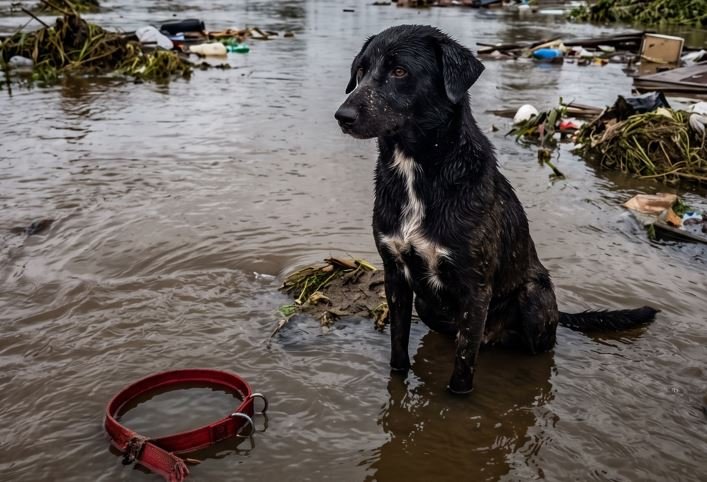
18 months later.
Arjun was not looking for Kali anymore. He had stopped looking after 6 months, when hope became cruelty. He worked now at a chai stall near the Kumbh Mela grounds — the massive religious fair that drew millions, that created temporary cities, that swallowed individuals into crowds so vast that identity disappeared.
He made chai. Poured it. Collected cups. The particular anonymity of a man who had lost everything and found only routine.
Kali was alive.
Not well. Not whole. But alive. She had survived the flood by clinging to debris, by swimming until her legs gave out, by being found by a family who took her in, who fed her, who called her “Lucky” because she had survived when so many hadn’t.
But she was not Lucky.
She was Kali. And she knew it. She sat in their courtyard, day after day, nose to the wind, tracking scents that were not there — neem, turmeric, the particular smell of a man who had rubbed his hands every evening and let her press her nose to his palms.
She ran away three times.
Each time, she was caught. Returned. Tied with a stronger rope, a heavier chain, the particular imprisonment of a dog who was loved by the wrong people. She stopped eating. Stopped wagging. Sat, present, waiting for a scent that did not come.
The family gave up.
Not cruelly. Practically. They brought her to the Kumbh Mela — to the massive temporary city, to the crowds of 10,000, to the particular chaos where a lost dog might find a new home or disappear into anonymity.
They left her near the chai stalls.
Not tied. Just left. A black dog with a white crescent, sitting in dust, watching millions of feet pass, tracking millions of scents, finding none that mattered.
Arjun was making chai.
His hands moved automatically — milk, sugar, tea leaves, the particular rhythm of a man who had done this thousands of times. He rubbed his palms together, habit, the ghost of a ritual that had once meant everything.
He had used the cream that morning.
Not deliberately. He had found the old jar in his concrete room, had opened it, had smelled neem and turmeric and his mother’s ghost and the particular memory of a dog who had pressed her nose to his palms every evening for four years.
He had rubbed it on. Just once. Just because.
Now his hands smelled like the past.
Kali smelled it from 50 feet away.
Not gradually. Instantly. Every fiber of her being — the particular organ that processes scent, that stores memory, that connects smell to emotion in ways that humans cannot understand — fired at once.
She stood.
Rigid. Nose to the air. Tracking. The scent was faint, buried under diesel and incense and the particular stench of 10,000 unwashed bodies. But it was there. Neem. Turmeric. The particular chemistry of Arjun’s skin, unchanged in 18 months, unmistakable in a lifetime.
She ran.
Not walked. Ran. Through the crowd, between legs, under carts, past the particular obstacles that would have stopped any other dog. She was a black arrow in a sea of color, a single purpose in a world of distraction.
People shouted. Tripped. Cursed. She didn’t hear them. She heard only the scent, growing stronger, closer, more real with every step.
Arjun was pouring chai.
His back to the crowd. His hands moving. The particular rhythm of a man who had forgotten that rhythm could be broken.
Kali hit him from behind.
Not aggressively. Not jumping. Just hitting — her body against his legs, her nose to his hands, her particular weight pressing into him with a force that made him stumble, that made him turn, that made him look down.
He saw black fur. White crescent. Eyes that held the particular patience of a creature who had waited 18 months for a scent to return.
He didn’t believe it.
Not at first. Not in the way that belief works. He believed in routine. In chai. In the particular emptiness of a life that had lost its center. He did not believe in miracles. In returns. In dogs who survived floods and found their way through crowds of 10,000 to press their nose to a hand that smelled of neem and turmeric.
Kali licked his palm.
Once. Twice. The particular gesture — the ritual, the evening, the day is done — that she had performed every day for four years and every night in her dreams for 18 months.
Arjun fell to his knees.
In the dust. In the crowd. In the particular chaos of the Kumbh Mela where millions sought salvation and one man found it in a black dog with a white crescent. He wrapped his arms around her. He buried his face in her fur. He smelled river water and dust and 18 months of waiting and the particular scent of survival that is stronger than any flood.
He pulled out the collar.
The frayed red nylon. The broken clasp. He had carried it for 18 months, every day, every hour. He held it in his shaking hands. He looked at Kali. At the place where it had snapped. At the dog who had survived without it and found him anyway.
He didn’t put it on.
Not the old one. He bought a new one — leather, strong, the particular permanence that the old one had failed to provide. He buckled it around her neck. He pressed his palms to her nose — neem, turmeric, the particular smell of a ritual restored.
Kali sighed.
The same sigh. The human sigh. The tired, resigned, grateful sound that she had made in a shelter, in a flood, in a courtyard where she was called Lucky by people who did not know her name.
She was Kali again.
Not Lucky. Not lost. Not waiting. Just Kali. The dog who had found her person in a crowd of 10,000 because love is a scent that cannot be drowned, cannot be forgotten, cannot be replaced by any other smell in the world.
Part 3: The Return
They went back to the river.
Not to the old hut — that was gone, washed away, memory. To a new spot. Higher ground. A small house made of concrete and hope, with a window that looked at the Yamuna and remembered.
Arjun fished again.
Not every day. Not for money. Just for ritual. Just for the particular rhythm of casting nets at dawn, of sitting in a boat with a black dog whose nose tracked the wind, whose presence made the river bearable.
Kali sat in the boat.
Same position. Same patience. Same eyes that held the particular certainty of a creature who had found her person, lost him, found him again, and would never — not for any flood, any crowd, any distance — let him go.
She was 10 when she died.
Not from the flood’s damage — though her hips ached, though her lungs were never quite right, though she carried the particular scars of survival in her body and her dreams. She died old, full, complete. In the boat. At dawn. With Arjun’s hand on her head and the smell of neem and turmeric in her nose and the particular peace of a creature who had kept her promise.
Arjun buried her by the river.
Not in a pet cemetery. Not marked with stone. Just earth, water, the particular return to the elements that had shaped her. He didn’t carve her name. He didn’t need to. The river knew. The wind knew. The particular scent of neem and turmeric that he still rubbed on his hands every evening — that knew.
He fished alone for three years.
Then he found another dog. Not black. Not with a crescent. Just a dog. A stray. Hungry. Waiting. He didn’t name her Kali. He named her Ritu — season — because she came in spring, because everything returns, because the particular cycle of loss and finding is the only truth that the river teaches.
Ritu sat in the boat.
Not the same. Never the same. But enough. The particular enough that comes from a man who has learned that love is not a single story but a series of them, each one complete, each one irreplaceable, each one leading to the next.
Every evening, Arjun rubbed his hands with neem and turmeric.
Ritu pressed her nose to his palms. She sighed. The same sigh. The human sigh. The tired, resigned, grateful sound of a creature who had found her person and needed nothing else.
And sometimes, when the wind shifted, Arjun smelled something else.
Not Ritu. Not neem. Not turmeric. Just a memory. A black dog. A white crescent. The particular scent of a flood that had taken everything and given back the only thing that mattered.
He didn’t cry.
Not anymore. He just sat in his boat, with his dog, on his river, and he breathed. In. Out. The particular rhythm of a life that had been broken and mended and broken again and mended again, until the mending became the story and the breaking became just another part of it.
Kali stayed.
Not in the way that ghosts stay. In the way that love stays. In the scent of neem and turmeric, in the sigh of a dog pressing her nose to his palm, in the particular knowledge that some bonds survive floods, survive crowds, survive death itself.
She stayed.
And every evening, when Arjun rubbed his hands and Ritu sighed, the river carried that staying outward, into the current, into the wind, into the particular infinity where all returns eventually find their way home.