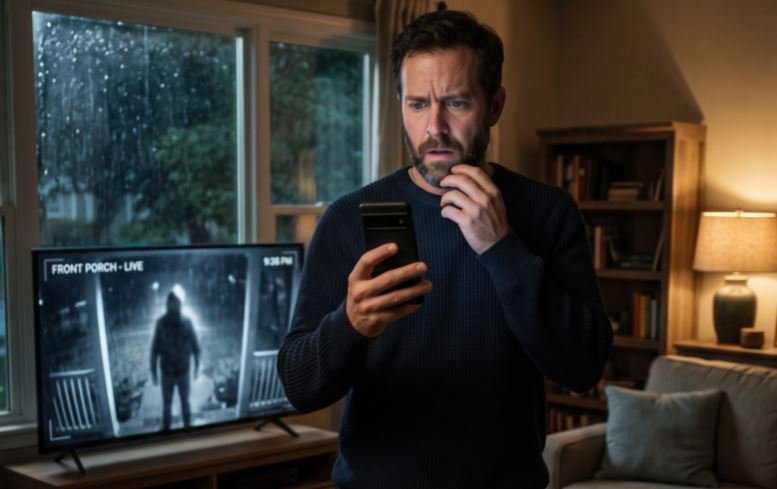
Daniel Reed was driving home from work on a rainy Tuesday evening when his phone vibrated with a security alert.
He glanced at the screen expecting another motion notification from his house. The camera occasionally detected passing cars or tree branches moving in the wind, so he almost ignored it. Instead, he opened the notification while sitting at a red light.
The video showed his front porch.
At first, nothing seemed unusual. Rain was falling beneath the porch light, and the street was almost empty.
Then someone walked into the frame.
Daniel stared at the screen.
The man was wearing dark jeans, a gray jacket and a black baseball cap.
Daniel was wearing exactly the same clothes.
The man walked toward the front door, reached into his pocket and unlocked it.
Daniel’s hands tightened around the steering wheel.
He checked the dashboard clock.
He was still twenty-three minutes away from home.
For several seconds he simply watched the recording again.
The man on the screen had the same height, the same build and even the same distinctive way of walking.
Daniel had no idea what he was looking at.
He immediately switched from the recorded alert to the live camera.
The porch appeared completely empty.
He refreshed the feed.
Nothing.
The rain continued falling.
Then another notification appeared.
Daniel opened it.
The thumbnail showed his living room.
He could see the sofa, the television and the wooden cabinet near the hallway.
But the camera had never been installed inside the living room.
Daniel suddenly pulled his car into a parking lot and called the police.
While waiting, he opened the notification again.
The image was only a few seconds long.
It showed his living room from an angle he didn’t recognize.
Then something caught his attention.
On the coffee table was a small glass paperweight.
Daniel had thrown that paperweight away almost six months earlier.
He knew because it had cracked during an argument with his brother.
Daniel had completely forgotten about it until that moment.
The police arrived at his location and reviewed the footage.
They initially suspected that someone had gained access to his security account.
But when they checked the account history, there were no unusual logins.
The camera had recorded the footage normally.
There was no evidence that the video had been uploaded or edited.
An officer asked Daniel whether anyone else had ever had access to his house.
He thought for a moment.
Then he remembered something.
Six months earlier, while he was away for a business trip, a contractor had been hired to repair a damaged section of his basement.
Daniel had given the contractor a temporary access code.
The code had supposedly been disabled after the work was completed.
The police checked the old records.
The code had indeed been disabled.
But the officer discovered something unusual.
The contractor’s company had reported a stolen set of electronic access devices around the same time.
Nobody knew where those devices had gone.
Police searched Daniel’s house that night.
Nothing appeared disturbed.
Every door was locked.
Every window was closed.
There was no sign that anyone had entered.
Then one officer noticed something near the basement.
A section of the wooden trim beside the stairs looked slightly newer than the surrounding material.
They removed it.
Behind it was a narrow gap leading into the wall.
Inside the space was an old electronic access device.
It wasn’t connected to anything.
But it contained a small memory card.
The police examined it.
The card contained hundreds of short recordings.
Most showed ordinary footage from Daniel’s house.
Some were several months old.
Others had been recorded recently.
The strangest recordings showed Daniel entering and leaving the house.
The dates didn’t match.
In several videos, the timestamp showed Daniel arriving home at times when he was known to have been somewhere else.
The police initially believed the recordings were fabricated.
Then they found one video that changed the investigation.
It showed Daniel entering his house late one evening.
He walked through the hallway and placed his keys on the kitchen counter.
The recording looked completely normal.
Except Daniel had been out of town that night.
His phone records, hotel receipt and work schedule confirmed it.
The man in the recording looked exactly like him.
But there was one difference.
He wasn’t wearing Daniel’s usual watch.
The police compared the footage frame by frame.
They discovered that the watch was an older model Daniel had stopped wearing several years earlier.
Suddenly, the recordings began to make sense.
Someone had apparently been recreating Daniel’s appearance and movements inside the house.
But why?
Investigators returned to the old contractor records.
The contractor who had worked on Daniel’s basement had left the company shortly afterward.
His former employer told police he had moved to another state.
But his name appeared in an unrelated investigation involving stolen property and unauthorized access devices.
Police eventually located him.
During questioning, he denied ever entering Daniel’s house after the repair.
He also denied knowing anything about the recordings.
Then investigators showed him the footage.
He remained silent for almost a minute.
Finally, he asked one question.
“How did you find that camera?”
The police hadn’t told him there was a camera.
They hadn’t even told him about the hidden memory card.
That question changed everything.
The contractor eventually admitted that he had returned to several properties after completing repairs. He had used old access information to enter homes and had installed small cameras in places where homeowners would never think to look.
But he insisted he hadn’t created the recordings of Daniel appearing inside the house.
According to him, someone else had used the equipment.
The investigation remained open.
Daniel changed every lock, replaced his security system and moved the cameras throughout the property.
But there was still one recording nobody could explain.
It was the original video that had started everything.
The footage of Daniel unlocking his front door twenty-three minutes before he actually arrived home.
Investigators examined the video repeatedly.
They couldn’t determine whether it had been recorded earlier, manipulated later or created using someone who looked remarkably similar to Daniel.
Then an officer noticed something in the background.
As the man opened the front door, he briefly turned toward the camera.
For less than a second, his face was visible.
It wasn’t Daniel.
It was the contractor.
But that created an even bigger question.
The contractor had been wearing Daniel’s jacket.
The same jacket Daniel was wearing that night.
The jacket had been inside Daniel’s house for months.
The police never established how the contractor had obtained it.
Daniel still has the original security notification saved on his phone.
He says the part that bothers him isn’t seeing someone who looked like him.
It’s realizing that the person in the video knew exactly what he would be wearing that night.
And they knew exactly when he would be coming home.
The final question remains unanswered:
Was someone predicting Daniel’s movements… or had someone been inside his house long before he ever noticed?