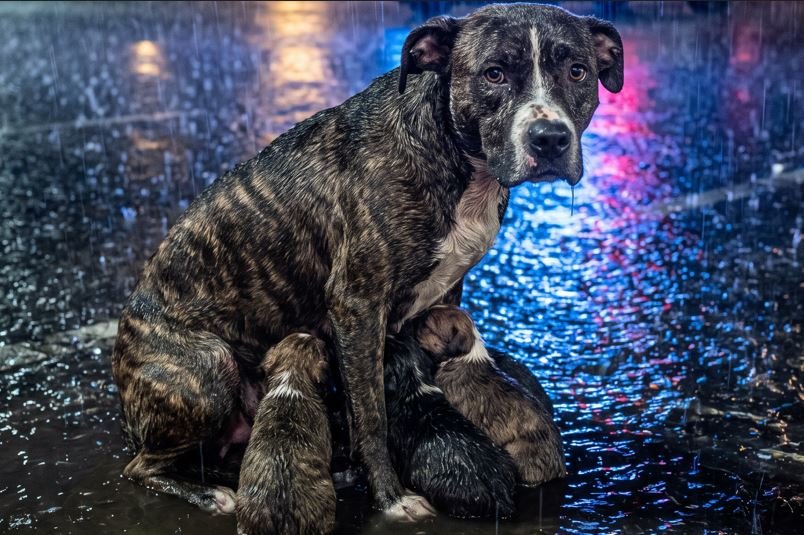
David’s apartment was small. One bedroom. A kitchen with a table that wobbled. A couch that had survived college and two failed relationships.
He didn’t have dog food. He didn’t have a box. He didn’t have towels that weren’t already in the laundry basket.
He used his own bathrobe. The blue one his mother had given him. He laid it on the kitchen floor, and the mother dog immediately circled it, sniffing, testing, before she lay down and the puppies found her. They latched on with weak, frantic movements, their tails vibrating with relief.
David stood in the doorway, soaked to the bone, and realized he didn’t know what to do next.
He made rice. Plain, white, boring rice. He had chicken broth in the fridge — leftover from a soup he never finished. He mixed them together in a bowl and placed it on the floor.
She didn’t eat immediately. She waited until all four puppies had stopped trembling. Until their suckling became rhythmic, peaceful. Then she stood, walked to the bowl, and ate. Not fast. Not desperate. Methodically. Building strength she would need later.
David sat on the kitchen floor, his back against the cabinets, and watched her.
She finished eating. She drank water from a saucepan. Then she returned to her puppies, curled around them, and looked at David.
Not with the empty gratitude of an animal that had been fed. With something else. Something that made him look away first.
He slept on the couch that night. She slept on his bathrobe. In the morning, he called in sick for the first time in three years.
The vet said the puppies were malnourished but stable. The mother had worms, fleas, and an infection in her left ear. But she was strong. Stronger than she should have been.
David paid the bill with money marked for new tires.
He told himself it was temporary. Just until the shelter had space. Just until the puppies were old enough. Just until he figured out what to do with five dogs in a one-bedroom apartment.
The puppies opened their eyes on day twelve.
They were blue, all of them. The cloudy, uncertain blue of newborns. But one of them — the smallest, the one who had been coldest in the rain — looked at David with eyes that were already turning brown. Already seeing him. Already choosing him.
He named her Hope. Because he couldn’t help himself.
The other three went to homes David vetted personally. He interviewed adopters like they were applying for security clearance. He visited their houses. He called references. The mother watched each one leave with a stillness that broke his heart.
But she stayed.
He named her Blue. Because of the light she had sat under. Because of the bathrobe she had claimed. Because of the color his life had been before she walked into it.
Six months later, David transferred to the K9 unit. Not because he planned to. Because Blue had learned every command in three weeks. Because she could find a hidden person in a warehouse in ninety seconds. Because when she looked at him, she saw something he was still learning to see in himself.
Someone worth following.
They still live in the same apartment. It’s smaller now, somehow, with a dog bed in every room and a kitchen table that still wobbles. David bought new towels. He never got new tires.
And on rainy nights, when the storms come hard and the gutters overflow, Blue sits by the window. She doesn’t bark at the thunder. She just watches. Remembering, maybe. Or waiting.
For the next one.
For the mother who will walk through rain with puppies in her mouth, looking for a light that looks like help.
And when that night comes, David will be ready. Because she taught him something no academy ever could:
You don’t become a hero by saving someone.
You become a hero by being the first door that doesn’t close.