He followed.
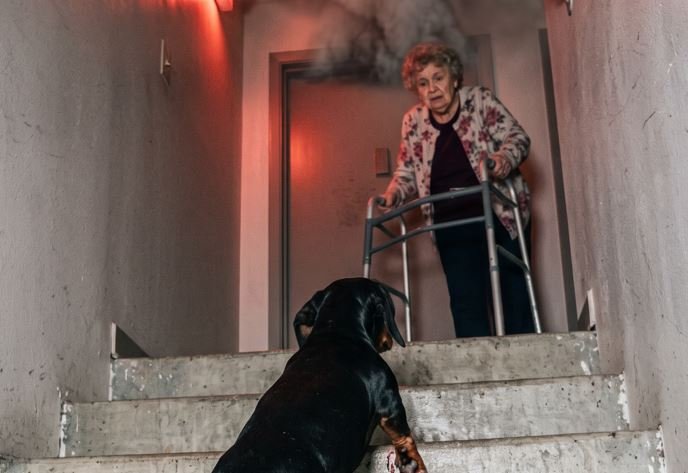
Not ran. Not jumped. He placed his front paws on each step, then dragged his back legs up behind him. His spine compressed. His hips ground together. He made a sound — not a whine, not a bark, something between a grunt and a prayer.
Rose heard it. She stopped on step 12. She turned. She saw him.
“Milo,” she whispered. “Go back, baby. Go back and wait.”
He kept coming. Step by step. Drag by drag. His eyes were on her. Not on the stairs. Not on the smoke that was beginning to seep under the stairwell door above them. On her.
She couldn’t carry him. He was 18 pounds, but her arms were 91 years old. She couldn’t leave him. He was her last thing.
So she descended slower. One step. Pause. One step. Pause. Letting him keep pace. Letting him rest. The smoke thickened. The air grew hot. Somewhere above, they heard the fire — not flames, but the sound of things breaking, of structure surrendering.
Step 200. Step 400. Step 600.
Milo’s back legs stopped working at step 847.
He tried to drag them. They wouldn’t respond. He tried to stand. He collapsed. He lay on the step, his chest heaving, his tongue gray with ash, and he looked at Rose.
She sat down beside him. On the concrete. In the smoke. She pulled him into her lap. He was too big for her lap, but she made him fit. She wrapped her arms around his sausage body and she waited.
For death. For rescue. For whatever came first.
Milo didn’t wait.
He squirmed. He pushed with his front paws against her chest. He wasn’t trying to get comfortable. He was trying to get up. His back legs dangled uselessly, but his front legs — his front legs still worked.
He used them.
He pushed off Rose’s chest and launched himself down the next step. He hit the landing with his chin. He scraped his nose. He stood on his front legs alone, his back legs trailing behind him like broken wheels, and he looked up at Rose.
Come on.
She stared at him. This ridiculous dog. This broken sausage. This creature who had never climbed more than three steps, who was now trying to descend 27 floors on two legs.
She stood. Her knees screamed. Her lungs burned. She picked up her walker and she followed him.
He moved like a soldier crawling through mud. Front paws down. Drag. Rest. Front paws down. Drag. Rest. Each step was a battle. Each landing was a war. The smoke grew thicker. The heat pressed down from above. Rose coughed. Milo coughed. They kept moving.
Step 1200. Step 1500. Step 1800.
They passed the 10th floor. The 5th. The 2nd.
The lobby was chaos. Firefighters. Smoke. Water. Shouting. Someone grabbed Rose. She fought them. “My dog! My dog!”
They didn’t see him at first. He was beneath her walker, half-hidden in the smoke, still dragging himself forward on two legs. A firefighter knelt. He picked Milo up. The dog was limp. Unconscious. The firefighter ran with him, out into the night, into the cold, into the oxygen.
Rose followed.
They laid Milo on the ambulance bumper. Oxygen mask. IV. The vet said later his spine had suffered permanent damage. His back legs would never work again. He would need a wheelchair. He would need diapers. He would need someone patient enough to love a broken sausage.
Rose signed the papers. All of them. Whatever they needed.
Milo woke up at dawn. He was in a cage at the emergency vet, confused, in pain, his back legs wrapped, his front legs bandaged from the concrete. He saw Rose. He tried to stand. He couldn’t. He tried to wag. He could.
She took him home three days later. Not to the Hartwell Towers — burned, condemned, gone. To a ground-floor apartment. One step to the porch. No stairs. Ever again.
She bought him a wheelchair. She learned to change diapers. She carried him to the bench by the fountain, 40 meters, and she held him while he sniffed the same bush for ten minutes.
He died two years later. Not from the fire. From old age. From a heart that had simply done too much.
Rose buried him beside the fountain. She visits every day. She sits on the bench. She watches the young people rush past with phones and headphones and lives that move too fast.
And she tells them, sometimes, when they pause to pet the stray cats:
“That dog climbed 27 floors on two legs. Not because he could. Because I couldn’t carry him, and he wouldn’t let me leave him behind.”
She doesn’t cry anymore. Not often. But when she does, it’s not for Milo.
It’s for the stairs. For the smoke. For the moment when a broken dog looked at her and said, with nothing but his eyes:
We go together. Or not at all.