The tornado formed at 1:47 AM.
Not predicted. Not on the evening forecast. The particular meteorology of the Great Plains — warm air from the Gulf, cold air from Canada, the particular collision that creates monsters while people sleep. It touched down six miles west of Jack’s building, a thin rope that widened as it fed, that found the particular energy it needed in the dark.
The sirens failed.
Not completely. They sounded at 2:14 AM — but only the northern array. The southern array, the one that served Jack’s county, had a transformer fault. The particular failure of infrastructure that happens when counties cut budgets and hope for the best.
Jack was asleep.
His hearing aids on the nightstand. His world silent. The particular silence of a man who has made peace with deafness, who finds safety in it, who doesn’t know that the world is screaming.
Watts was awake.
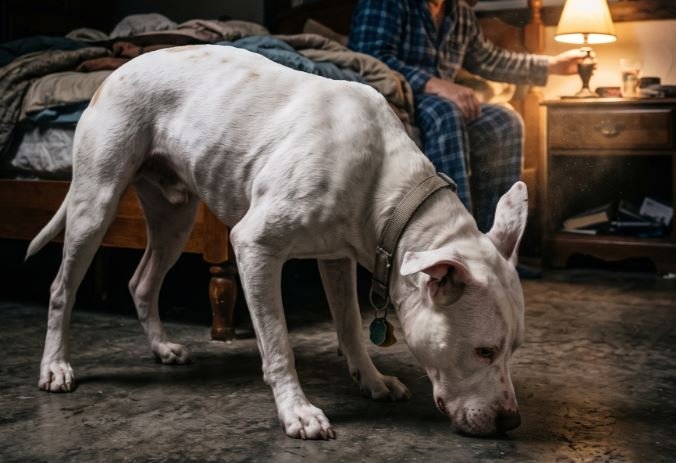
Not because of sound. Because of pressure. The particular drop in barometric pressure that precedes a tornado — the air thinning, the atmosphere contracting, the particular physics that animals feel in their joints, their sinuses, their paws. Watts felt it through the concrete. A change. A wrongness. The particular frequency of danger that no lamp could signal.
He stood.
In the dark. On the concrete. Every muscle rigid. His nose worked the air — ozone, dust, the particular scent of destruction that travels ahead of the wind. He felt the vibration through his paws grow stronger. Not trucks. Not wind. Something else. Something that made the concrete hum.
He went to Jack.
Not barking — barking was useless, Jack couldn’t hear, and Watts couldn’t hear himself anyway. He used his weight. He jumped onto the bed — 65 pounds landing on Jack’s legs. He pressed his body against Jack’s chest. He pawed at Jack’s face, his nose, the particular insistence of a creature who knows that time is short and silence is deadly.
Jack woke.
Confused. The particular confusion of a deaf man woken in darkness, unable to hear what is wrong, relying on touch and instinct. He felt Watts — rigid, trembling, the particular anxiety that he had never seen in the dog, not in storms, not in fireworks, not in any of the stimuli that frightened other animals.
He turned on the light.
The lamp by the bed. And through the window, he saw it. Not clearly — the darkness, the distance, the particular obscurity of night. But he saw the flash. Not lightning. Something steadier. Something that pulsed with its own electricity, that threw shadows in a spiral, that was moving across the wheat field toward his concrete house.
He had thirty seconds.
Not to think. To move. To remember the drills from his childhood, from his radio station days, from the particular knowledge that every Kansan carries like a spare tire. The storm cellar. Twenty feet from the house. Concrete steps. Metal door.
He grabbed his hearing aids.
Not to wear — no time. Just instinct. He shoved them in his pocket. He grabbed Watts’s collar — not the leash, no time — and he ran. Out the door. Into the wind. The particular wind that wasn’t wind yet, that was just the beginning, that was pulling the air toward the vortex like water down a drain.
Watts pulled ahead.
Not away from the cellar. Toward it. He felt the vibration of Jack’s footsteps behind him, but more — he felt the vibration of the ground itself, the particular frequency of the tornado’s approach, the particular wrongness that made every instinct scream down, get down, get below. He reached the cellar door first. He scratched at it. He turned to Jack, eyes wide, body vibrating with the particular urgency of a creature who has never heard a siren but knows what death sounds like.
Jack opened the door.
They descended. Jack pulled the door shut. The particular darkness of a storm cellar — dirt walls, concrete floor, the smell of earth and old potatoes and the particular safety of underground. He reached for the latch. The wind hit.
It wasn’t sound. It was pressure. The particular force of atmosphere moving at 140 miles per hour, hitting the cellar door, trying to peel it open, to pull them out, to finish what it had started. Jack held the latch. Watts pressed against him. His body — 65 pounds of muscle and fear and the particular loyalty of a dog who has found his person — braced against Jack’s legs, adding weight, adding stability, adding the particular physics of survival.
The door held.
For ninety seconds. The particular eternity of a tornado passing overhead — the freight train sound that Jack couldn’t hear, the pressure change that made his ears pop even without aids, the particular terror of knowing that your house, your life, your forty years of collected jazz records and vintage microphones and the particular accumulation of a solitary existence, was being unmade above you.
Then silence.
Not complete. The particular aftermath silence of a world that has been edited — some things removed, some things added, the particular disorientation of surviving. Jack waited. He counted to sixty. He counted to sixty again. He pushed the door.
It opened hard. Debris on top. He climbed out.
The transmitter building was gone.
Not damaged. Gone. The particular erasure of a tornado — the cinder-block walls scattered across the wheat field like dice, the roof a mile east, his bed, his kitchen, his life, distributed across forty acres of Kansas farmland. Where the building had stood, there was only foundation. Only concrete slab. Only the particular geometry of a life that had been lifted and examined and discarded.
Watts climbed out beside him.
He didn’t bark. Didn’t whine. He just stood. Nose to the wind. Reading the particular aftermath — ozone, diesel from a ruptured truck tank, the particular scent of destruction that was already becoming the scent of morning. He pressed against Jack’s leg. Jack put his hand on his head.
They stood together.
In the gray light of 2:47 AM. In the particular silence that Jack had always sought, that was now absolute, that was now the only thing left. He reached into his pocket. He pulled out his hearing aids. They were crushed. The particular technology that had connected him to the world, that had failed him when the sirens failed, that was now as useless as the building behind him.
He dropped them.
Into the dirt. He didn’t need them. Not anymore. Because he had Watts. Because Watts didn’t need him to hear. Because the particular bond between them — built on vibration, on presence, on the particular language of two creatures who had been discarded for their silence — was stronger than any siren, any technology, any storm.
Part 3: The Broadcast
The video went viral.
Not from Jack. From a storm chaser — a young woman, 28, who had been tracking the tornado from three miles away, who had filmed the transmitter building being lifted and scattered, who had captured the moment when the cellar door opened and a deaf man and a deaf dog emerged into the dawn.
67 million views.
The algorithm — that mysterious, merciless god — had found its offering. A tornado. A deaf man. A deaf dog. The particular story that the internet loves — disability as superpower, the underdog who survives, the particular miracle of a rescue that wasn’t planned, that wasn’t trained, that was just love and vibration and the particular refusal to die.
Jack didn’t watch the video.
He couldn’t hear it. He didn’t need to. He was busy — rebuilding, not the building, but a life. The radio station that had fired him offered him a new show. Not late night. Morning drive. The Static and Watts Show. They built a studio that flashed lights instead of sounding bells. They hired an interpreter for call-ins. They made accessibility the particular feature that became the show’s identity.
Watts came to the studio every day.
He slept on the floor, nose to the concrete, feeling the particular vibration of the building, the city, the world. When Jack was on air, Watts would lift his head if the floor hummed wrong — trucks too close, weather changing, the particular sensitivity that made him more reliable than any equipment.
He became the station’s mascot.
Not officially. Just… practically. The particular symbol of what the show represented — that silence wasn’t empty, that disability wasn’t deficit, that the particular frequencies that most people couldn’t hear or feel were still real, still important, still worth broadcasting.
Jack told the story.
On air. In interviews. In the particular way that survivors have of repeating their trauma until it becomes narrative, becomes myth, becomes something that helps other people survive their own storms.
“He didn’t hear the sirens,” Jack said. “I didn’t either. But he felt the tornado in the concrete. In his paws. In the particular way that the world speaks to those who are willing to feel instead of just listen.”
He paused. He looked at Watts, who was sleeping on the studio floor, one ear up, one ear down, the particular posture of a creature who had found his frequency.
“I was going to let them put him down,” Jack said. “Because he was deaf. Because he didn’t listen. Because I thought that meant he was broken.” He smiled. The particular smile of a man who has learned that his definitions were wrong. “But he was listening. Just not with his ears. He was listening with everything else. And that’s what saved us.”
Watts died at 13.
Not from the tornado. From age. From the particular decline of a dog who had lived long and well, who had felt the world deeply, who had taught a deaf man that silence was not absence but presence.
Jack buried him beneath the new transmitter tower.
Not the old building — that was never rebuilt. But the new tower, digital, modern, flashing red lights against the Kansas sky. He buried Watts where the concrete was thickest, where the vibration of the tower’s base would travel through the earth, where Watts could feel — even in death — the particular hum of a signal going out.
The marker was simple. Jack carved it with his own hands, the particular craftsmanship of a man who had spent his life working with sound and had learned, finally, to work with silence.
It read:
WATTS — He Couldn’t Hear the Sirens. He Felt the Storm. He Taught Me to Listen with My Hands.
Jack still broadcasts.
Every morning. The Static and Watts Show. He has a new dog now — a young deaf pit mix, rescued from the same shelter, scheduled for the same fate. Her name is Hertz. She sleeps on the studio floor. She feels the concrete. She carries the particular legacy of a dog who proved that the world speaks in frequencies that most of us are too distracted to feel.
And sometimes — at 2:14 AM, when the station is quiet and the wheat is dark and the particular silence of Kansas settles over everything — Jack turns off his hearing aids. He takes off his shoes. He presses his bare feet to the floor.
He listens.
Not with his ears. With his skin. With his bones. With the particular understanding that Watts gave him — that the world is always speaking, always warning, always whispering its secrets to those who are still enough to feel them.
He listens.
And somewhere — in the particular frequency where deaf dogs go, where the concrete is warm and the vibrations are gentle and the storms never come — Watts listens too.