Marcus Delgado had stopped raising his hand in Mrs. Whitfield’s class months before the incident that finally got her removed from it, a fact his mother, Elena, didn’t fully understand until she sat down with the district supervisor and reviewed six months of quietly accumulated concerns.
Mrs. Whitfield had taught seventh-grade English at Jefferson Middle School for nineteen years, long enough to have built a reputation among parents as either a rigorous, old-school disciplinarian who got results, or something considerably harder to name, depending on who you asked. Elena had heard both versions before Marcus started the school year in her class, and had hoped, optimistically, that her son would land in the first category rather than the second.
It became clear within the first month that Marcus had not. He came home increasingly quiet after school, his easy chatter about lunchtime jokes and video games replaced by a flat, monosyllabic account of his day that made Elena’s stomach tighten every time she asked how class had gone. It took weeks of gentle, patient questioning before Marcus finally admitted, almost in a whisper, that Mrs. Whitfield had a habit of singling him out during class discussions, correcting him sharply in front of everyone for mistakes other students made without comment, and once, after he’d stumbled through a reading passage aloud, telling the class that some students “just needed to accept that reading fluently wasn’t going to be their strength.”
Elena had emailed the school twice, requesting a meeting, and had received, each time, a polite but noncommittal response assuring her that Mrs. Whitfield maintained “high standards for all students” and that Marcus’s grades, while not exceptional, were “within a normal range.” Elena kept a folder anyway — dates, brief summaries of what Marcus reported after each difficult day, the two unanswered emails printed and filed — the same instinct that had served her well in every other frustrating institutional dead end she’d navigated as a single parent.
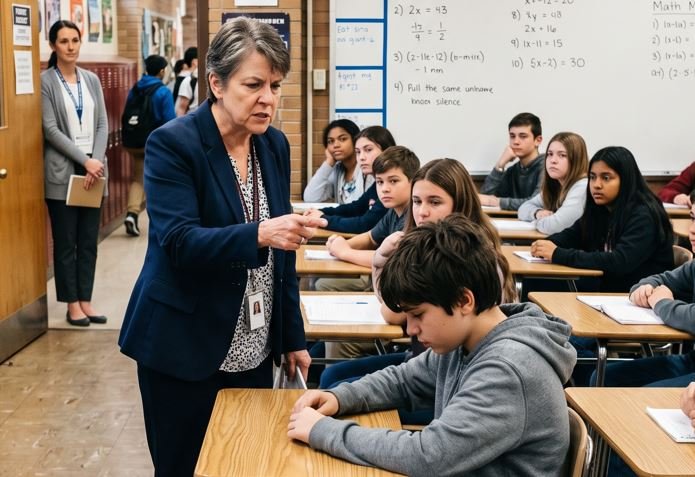
The incident that finally broke through the district’s polite indifference happened on an ordinary Tuesday, during a unit on persuasive essays. Marcus had turned in a rough draft the day before, one Elena had actually helped him revise over the weekend, both of them proud of how much clearer his argument had become after three drafts. Mrs. Whitfield, apparently unimpressed, had chosen to use his essay as a public example of what not to do, reading sections of it aloud to the class with a tone of exaggerated disbelief before setting it down and addressing the room directly.
“Let’s be honest, class,” she said, sharp enough that her voice carried clearly through the open classroom door and into the hallway beyond. “Some of you just aren’t cut out for real academic success. Isn’t that right, Marcus?”
Marcus stared at his desk, humiliated in front of twenty-six classmates, the classroom falling into the particular uncomfortable silence that follows a teacher saying something everyone recognizes as cruel but no twelve-year-old feels equipped to challenge out loud.
What Mrs. Whitfield hadn’t noticed was that Diane Okafor, the district’s curriculum and instruction supervisor, had arrived in the hallway moments earlier for a previously scheduled classroom observation — an unrelated, routine check unconnected to any complaint, timed by pure coincidence to land in the middle of that exact exchange. Diane had paused outside the open door, initially just waiting for a natural break to enter, and had heard the entire comment clearly before stepping fully into the doorway.
“Actually,” Diane said, her voice calm but carrying its own quiet authority, “I’d like to see you in the hall for a moment. Now, please.”
Mrs. Whitfield’s sharp confidence faltered instantly, visibly recalculating how much of her comment had just been overheard by someone considerably more senior than a parent’s polite email. She stepped into the hallway, and though the classroom door was mostly closed behind them, several students later reported hearing enough of the conversation’s tone, if not its exact words, to understand that their teacher was being firmly and seriously corrected.
Diane’s formal report, filed later that week, was thorough and unambiguous. It documented not only the comment she’d personally witnessed, but, once she began reviewing Elena’s previously ignored emails alongside interviews with several other parents who came forward once the investigation opened, a broader pattern spanning multiple school years — other students singled out for public correction in ways that went well beyond ordinary classroom discipline, other unanswered parent complaints quietly filed away without meaningful follow-up.
The district placed Mrs. Whitfield on administrative leave within the week, pending a formal review that ultimately resulted in her early retirement rather than returning to the classroom the following semester — a resolution the district characterized carefully in official language, but one that every parent who’d filed a complaint over the preceding years understood clearly enough for what it was.
Elena learned about the resolution the same way she’d learned about most of the ordeal — through a brief, formal email, followed by a considerably warmer phone call from Diane herself, who’d taken the unusual step of following up personally rather than leaving the news to district paperwork.
“I wanted you to know directly,” Diane said, “that your emails weren’t ignored because they didn’t matter. They just needed someone in the building at the right moment to finally take them seriously enough to act instead of just filing them. I’m sorry it took as long as it did.”
Marcus’s new English teacher for the second half of the year, a younger woman named Ms. Park, took a noticeably different approach from her first day — encouraging revision without ridicule, calling on students gently rather than as a test of public endurance. Marcus, cautiously at first and then with something closer to his old ease, started raising his hand again by the third week of the new semester.
Elena kept the folder of dates and printed emails long after the situation resolved, not out of lingering anger, but because she’d learned, watching it all finally unfold, that the difference between a complaint that disappeared into a filing cabinet and one that actually changed something often came down to nothing more than someone, somewhere, happening to be standing close enough to hear the truth for themselves.
She hoped, for Marcus’s sake and for every other quiet kid who might sit in that classroom in years to come, that the district wouldn’t need quite so much luck next time.
THE END