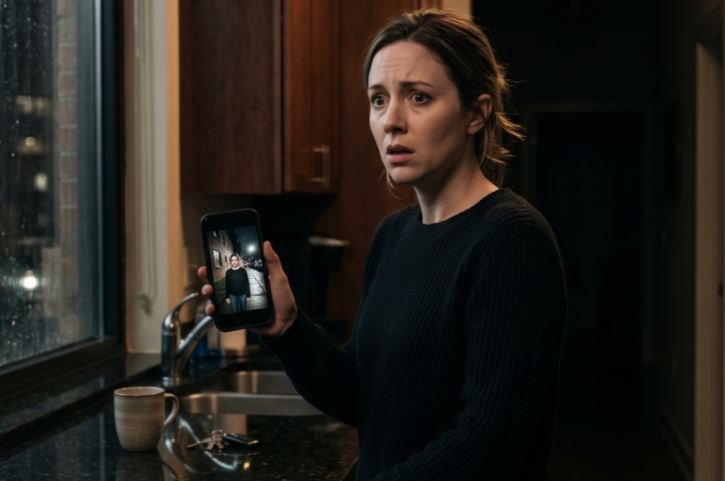
Sarah Mitchell was sitting alone in her apartment when her phone vibrated at 11:47 p.m.
It was a message from an unknown number.
There was no text.
Only a photograph.
Sarah opened it expecting spam.
Instead, she saw herself.
She was standing outside her apartment building, wearing the same gray sweater she was wearing at that exact moment.
The photograph looked completely real.
Sarah stared at it for several seconds before noticing something that made her stomach tighten.
She was standing outside.
She was inside.
And then she looked at the timestamp.
The photograph had been taken at 12:06 a.m.
Nineteen minutes from now.
Sarah immediately checked the image details.
The file contained no obvious editing history.
The photograph appeared to have been taken with a normal smartphone camera.
She called her sister.
While the phone was ringing, Sarah noticed something else.
There was a person standing behind her in the photograph.
A man.
He was partially hidden by a streetlight.
Sarah zoomed in.
His face was impossible to see.
She looked toward the window.
The street outside was empty.
She closed the curtains.
Then she heard something in the hallway.
Three slow footsteps.
Sarah stopped breathing.
Another sound followed.
The handle of her apartment door moved.
She grabbed her phone and backed away.
The handle stopped.
For several seconds, nothing happened.
Then her phone vibrated again.
Another message.
Another photograph.
Sarah opened it.
This time, the picture showed her apartment from the inside.
She could see herself standing near the kitchen.
The photograph had been taken from somewhere behind her.
Sarah slowly turned around.
Nobody was there.
She ran out of the apartment and called the police.
Officers searched the building.
They found no intruder.
No hidden camera.
No damaged lock.
Nothing.
One officer examined the photographs.
He initially believed they were manipulated.
Then he noticed something unusual.
The first photograph showed Sarah standing outside her building.
Behind her was a street sign.
The second photograph showed the inside of her apartment.
Both photographs had been taken from angles that would require someone to be physically present.
But there was no evidence anyone had entered.
The police asked Sarah whether anyone had been following her.
She said no.
Then they asked whether she had recently argued with anyone.
Again, no.
The case might have ended there if Sarah hadn’t received a third message.
It arrived at exactly 12:06 a.m.
The time shown on the first photograph.
The message contained no picture.
Only six words:
“You weren’t supposed to leave.”
Sarah stared at the screen.
Then she noticed something.
The sender was no longer an unknown number.
It was her own phone number.
Police later traced the original messages.
The first photograph had been sent through an anonymous internet service.
The second couldn’t be traced.
The third appeared to have originated from Sarah’s own device.
Investigators examined her phone.
Nothing.
No malware.
No unknown applications.
No suspicious account activity.
Then Sarah remembered something she had almost forgotten.
Six months earlier, she had lost her phone for several hours while traveling.
Someone had returned it to the hotel reception desk.
She had assumed a stranger had found it.
The police reopened that incident.
Security footage showed Sarah dropping the phone in the hotel lobby.
A man picked it up.
He looked at the screen.
Then he walked away with it.
Three hours later, he returned.
The footage was too blurry to identify him.
But investigators noticed something else.
The man had been carrying a small camera.
The case remained unsolved.
Months passed.
Sarah eventually moved to another city.
She changed her number.
She replaced every lock.
She deleted her old accounts.
She thought it was finally over.
Then, almost a year later, she received one final photograph.
There was no message.
No timestamp.
Just an image.
Sarah opened it.
It showed her sitting at her new kitchen table.
The photograph had clearly been taken from outside the house.
She immediately looked toward the window.
There was nobody there.
Then she zoomed in.
In the reflection of the glass, behind her…
stood the same man from the first photograph.
This time his face was visible.
Sarah recognized him.
It was the stranger who had returned her phone.
But there was one detail that made the photograph impossible.
The man had died three months earlier.
Sarah called the police.
Before she could explain anything, her phone received another notification.
A short video.
She pressed play.
The video showed her sitting at the kitchen table.
The exact moment she was watching it.
The camera slowly moved closer to the window.
And just before the video ended…
someone behind the camera whispered:
“Now you know why I chose you.”
The screen went black.
Sarah never received another message.
But investigators never discovered who had taken the photographs.
And to this day, the identity of the person behind the camera remains unknown.
The most disturbing question isn’t who was watching Sarah.
It’s this:
How did they know what she was going to do before she did it?