For nearly eight years, the disappearance of 34-year-old Daniel Reeves remained one of the county’s most frustrating cold cases.
Daniel had left a family gathering one summer evening and never arrived home. His phone stopped transmitting shortly after midnight, and despite extensive searches, investigators found no trace of him or his vehicle.
The case gradually faded from headlines.
Then, years later, a local fisherman named Mark Holloway was planning a new fishing trip.
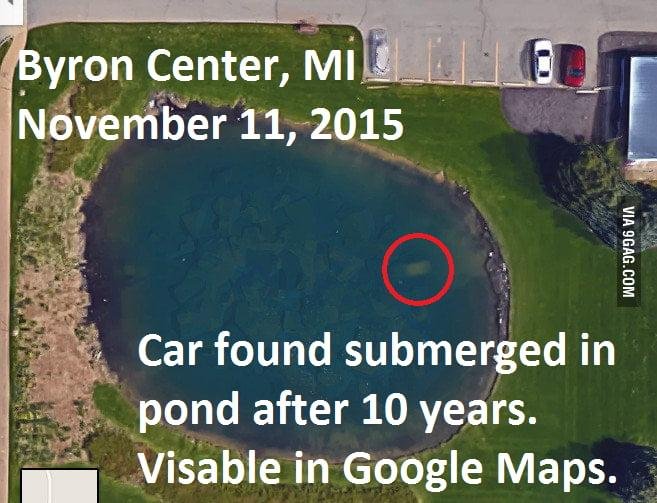
While exploring satellite images of remote lakes online, he noticed something unusual near the shoreline of Lake Mercer.
Just beneath the water’s surface was a rectangular shape.
At first glance, it looked like a submerged dock or a patch of darker vegetation. But the more Mark zoomed in, the more it resembled the outline of a vehicle.
Curious, he posted a screenshot in a local outdoor forum.
Within hours, other users began comparing the shape to different car models. One comment suggested contacting authorities.
Mark almost ignored the advice.
Instead, he called the sheriff’s office the next morning.
Deputies initially treated the report cautiously. Satellite imagery can create strange visual artifacts, and many similar tips turn out to be nothing.
Still, a small search team was sent to the lake.
Divers entered the water near the coordinates visible in the screenshot.
Less than twenty minutes later, they found a vehicle resting on the lakebed.
It was a silver sedan.
Records later confirmed that the license plate matched the car Daniel Reeves had been driving the night he disappeared.
The discovery stunned investigators.
The vehicle sat only about thirty feet from shore in relatively shallow water. Dense algae and sediment had concealed it from casual view, and earlier searches had focused on deeper sections of the lake.
When the car was recovered, authorities found evidence that Daniel had likely entered the water accidentally after missing a sharp turn on a dark rural road. There were no signs of foul play.
For Daniel’s family, the answer brought both grief and relief.
After years of uncertainty, they finally knew what had happened.
Investigators later acknowledged that the breakthrough came from an unexpected source: an ordinary person studying publicly available satellite images.
The case prompted local agencies to review other long-term missing-person investigations involving vehicles.
Several departments even began experimenting with aerial and satellite analysis as part of cold-case reviews.
What makes the story remarkable is not a supernatural mystery or a hidden conspiracy.
It’s the fact that a clue visible from space sat unnoticed for years.
Thousands of people had driven past Lake Mercer.
Boats had crossed it.
Search teams had worked nearby.
Yet the answer remained hidden in plain sight until someone happened to zoom in on the right spot.
Sometimes the final clue isn’t buried in a file cabinet or locked inside an evidence room.
Sometimes it’s waiting on a map that anyone can open.
And sometimes, solving a cold case begins with a single question:
“What is that shape in the water?”