Months passed.
Not easily. Kane bit a guard who reached into the cell without announcing himself — not Darius’s fault, but Darius took the blame, 30 days loss of privileges, the particular sacrifice of a man who understands that loyalty is the only currency that matters inside. Kane destroyed three mattresses, two bowls, one Bible — the particular destruction of a dog who was learning to trust but still needed to test boundaries.
Darius taught him.
Not with force. With patience. The particular patience of a man who has nowhere to be and nothing but time. He used a clicker — sanctioned by the program, provided by a volunteer trainer who visited monthly. He used treats. He used the particular consistency that Kane had never known.
“Sit.” “Stay.” “Down.” “Come.”
The basics. The foundation. The particular language that bridged the gap between human and dog.
But Darius taught him something else.
“Push.”
A game, at first. A red button mounted on a piece of wood. Push it with your nose, get a treat. The particular trick that Darius invented because he was bored, because Kane was smart, because the particular intelligence of a Presa Canario needs stimulation or it becomes destruction.
Kane learned fast.
Push. Treat. Push. Treat. The particular joy of a dog who has discovered that his actions have consequences, that he can control his environment, that the world responds to him instead of just hurting him.
Darius mounted the button on the cell wall.
Near the emergency call button. The particular red switch that inmates use to summon guards — for medical emergencies, for fires, for the particular moments when the state acknowledges that even prisoners need help.
He didn’t explain why.
He just taught Kane: “Push.” And Kane pushed. The red button. The emergency button. The particular connection between a dog’s nose and a system designed for humans.
The guards thought it was a trick.
They laughed. The particular laughter of men who have seen everything and are surprised by nothing. “Smart dog,” they said. “Dumb inmate teaching a dog to snitch on himself.”
Darius didn’t laugh.
He knew something the guards didn’t. He knew that he was 48. That his father had died at 52 of a heart attack. That his chest had been tight for weeks, that his left arm ached sometimes, that the particular warning signs of cardiac distress were present in a body that had spent 22 years eating prison food and breathing prison air and carrying prison grief.
He knew that he was going to die in Angola.
He just didn’t know when.
The night it happened, Kane was awake.
3:14 AM. The particular hour when prisons are quietest, when even the insomniacs have found sleep, when the world holds its breath. Kane was on the floor, nose to the air, reading the particular chemistry of the cell — sweat, soap, the particular scent of Darius’s skin that had become his universe.
Darius woke with pain.
Not gradual. Sudden. A vise across his chest, crushing, the particular weight of a body betraying itself. He sat up. Gasped. His left arm numb, his jaw tight, the particular constellation of symptoms that he had read about in a library book on cardiology.
He reached for the call button.
Too far. His cot was against the wall, the button mounted near the door, the particular design of a cell that prioritizes guard access over inmate safety. He tried to stand. His legs gave out. He fell to the concrete, his head hitting the floor, the particular sound of a skull against stone that echoed in the quiet.
Kane moved.
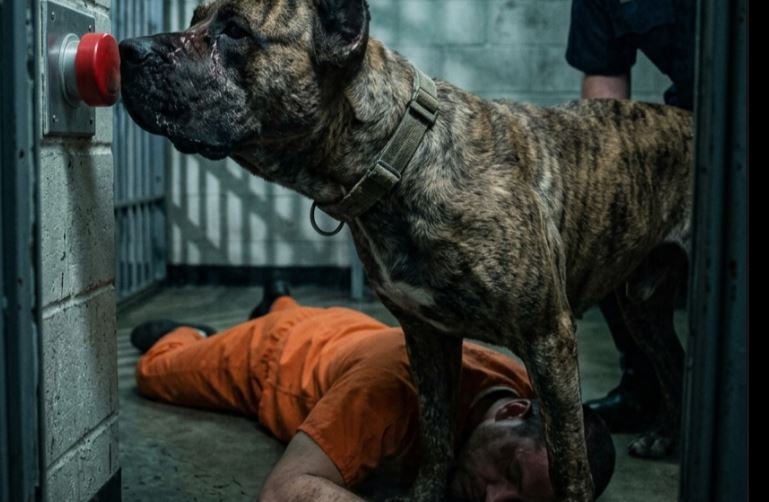
Not to attack. Not to protect. To the button. The red button. The particular switch that Darius had taught him to push, that he had pushed a thousand times for treats, that he now pushed because the particular frequency of Darius’s breathing had changed, because the particular scent of his skin had shifted to something sharp and wrong, because the particular bond between them had taught him that push meant help and Darius needed help.
He hit it with his nose.
Once. The alarm sounded — a bell, harsh, electric, the particular sound that guards hear and usually ignore because inmates push buttons for attention, for cigarettes, for the particular boredom that makes any stimulation desirable.
Kane hit it again.
And again. Not the gentle push of trick training. The frantic, repeated pressing of a creature who understands urgency, who has learned that one push gets a treat but many pushes get a response, who is using the only tool he has to save the only person who matters.
The guards came.
Not immediately. Two minutes. Three. The particular eternity of a heart attack in progress. They opened the cell door. They found Darius on the floor, unconscious, breathing but barely. They found Kane standing over him, not aggressive, not threatening, just present, his nose still near the button, his eyes on the guards as if to say finally. Finally. Do something.
They called a code.
Medical emergency. The particular machinery of prison healthcare — slow, reluctant, but eventually effective. They moved Darius to the infirmary. They intubated him. They stabilized him. They shipped him to the university hospital in Baton Rouge, where a stent was placed in a coronary artery that was 90% blocked.
He lived.
Not because of the prison system. Not because of the guards. Because of a dog who had been scheduled to die, who had learned to push a button, who had refused to let the only person who loved him disappear into the particular silence of a cell block at 3:14 AM.
Part 3: The After
The video went viral.
Not from the prison. From a guard — young, new, who had filmed the cell check, who had captured Kane pushing the button, who had posted it with the particular naivety of someone who doesn’t know that prisons don’t like publicity.
43 million views in 72 hours.
The algorithm — that mysterious, merciless god — had found its offering. A prisoner. A dog. A red button. The particular story that the internet loves — redemption, loyalty, the unexpected hero who comes from the place we discard.
People demanded Darius’s release.
Not realistically — he had killed a man, 22 years ago, in circumstances that were complicated but not exculpatory. But they demanded it anyway. They wrote to the governor. They started petitions. They called into radio shows with the particular passion of people who have seen a video and believe they understand a life.
The governor didn’t commute the sentence.
But he visited.
Not Darius — Kane. He came to Angola with cameras, with aides, with the particular entourage that politicians bring to moments that might win votes. He knelt before Kane’s cell. He offered his hand. Kane — who had learned to trust Darius but not humanity — sniffed it, assessed it, and turned away.
The governor laughed.
The particular laugh of a man who has been rejected by a dog and finds it charming. He announced funding. For the Last Chance K9 program. For prison dog partnerships across Louisiana. For the particular idea that creatures scheduled to die might save lives instead.
Darius returned to Angola after six weeks.
Not to the same cell — medical recovery, infirmary, the particular bureaucracy of prison healthcare. But eventually, to Kane. To the dog who had pushed a button and changed everything.
They were featured in a documentary.
Not the viral video — something longer, more produced, the particular media that turns moments into movements. Darius, in his cell, with Kane at his feet, talking about the particular lesson of a dog who had been given up on.
“He didn’t need me to fix him,” Darius said. “He needed me to stay. To be there when he woke up scared. To talk to him when the world was quiet. The button — I didn’t teach him that to save my life. I taught him because he was smart, and smart dogs need jobs. I just didn’t know the job would be me.”
Kane became the program’s mascot.
Not officially. Just… practically. The particular symbol of what Last Chance K9 could do — take the unmanageable, the unadoptable, the scheduled-to-die, and give them a purpose. Other inmates requested dogs. Other dogs were saved. The program expanded from Angola to three other Louisiana prisons.
Darius ran the training.
Not as a free man. As a lifer. But as a lifer who had found, in the particular twilight of his sentence, something that mattered. He trained dogs. He trained inmates. He taught them what he had learned from Kane — that patience is stronger than force, that consistency builds trust, that the particular bond between a human and a dog is the only freedom that prison cannot take.
Kane died at 9.
Not suddenly. The particular decline of a large dog who had lived hard and loved harder. He was buried in the prison cemetery — the particular plot where inmates who die inside are laid to rest, marked with numbers instead of names.
Darius carved the marker himself.
In the woodshop. In pine. The particular wood he used for coffins, repurposed for a headstone. He wasn’t supposed to — against regulations, against protocol, against the particular rules that govern even grief. But the warden looked away. The guards looked away. The particular conspiracy of silence that forms around love.
The marker read:
KANE — He Pushed the Button. He Saved the Man. He Proved That Last Chances Are the Only Chances That Matter.
Darius visits every day.
Not for long. Just… to sit. To be present. To tell Kane about the new dogs, the new inmates, the particular program that continues because of what a Presa Canario did at 3:14 AM on a Tuesday in March.
He is 61 now.
His heart is held together by a stent and medication and the particular will to live that Kane gave back to him. He will die in Angola. He knows this. He has made his peace with it.
But he will not die alone.
Because Kane taught him that. That even in a cell, even on death row, even in the particular darkness of a life sentence — there is love. There is loyalty. There is a red button on a wall that means help, and a dog who will push it, and a guard who will eventually come, and a story that will escape these walls and travel outward into the world.
Darius talks to Kane’s grave.
Not because he believes in an afterlife. Because he believes in presence. Because the particular act of speaking into silence is the only way to hold onto a voice that has faded, to a warmth that is gone, to the particular love that existed between a killer and a dog who had been scheduled to die in the same week.
“Push,” he says.
And for a moment — in the particular wind of Louisiana, in the particular heat of a prison cemetery, in the particular eternity where all stories eventually end — he imagines he hears a tail thump.
Once.
In response.